Showing posts with label PAKISTAN Karachi. Show all posts

Saturday, May 3, 2014

My Pakistan Diaries: A Day of Mehndi Madness

In March of 2013, I was invited to attend a wedding in Pakistan. I spent two  weeks in Karachi, Hyderabad, Lahore, and Islamabad. This is the account of my real experience there.  Out of respect for the privacy of my friends, I have not named anyone, and I will not be posting pictures of their faces, or providing details which may reveal their identities or locations. Read more about my diaries here

Wednesday, March 27th, 2013 
Karachi, Pakistan

In Pakistan, breakfast in served at noon.
I love any country where you can wake up at 10:00am and the host asks why you are up so early.

It was the morning after the Sangeet, and Hindu women from Karachi and surrounding villages in Sindh gathered in the living room of my host family for an hour of singing and dancing. I had expected something less formal compared to the previous evening, but when the women came, I was surprised at how dressed up they were for a midday event held in a living room. There were so many woman squeezed into the house that we danced around the sitting women, the tips of our colorful dupattas sometimes grazed a sitting guest.
[Author’s note: I learned after returning from Pakistan that this ceremony is called the Saat. I  regret not doing enough research on wedding customs before I came to Pakistan. At the time, I assumed that someone would explain everything to me in detail before it happened, but instead, events unraveled and I was given only brief explanations as they were happening.]
After the dancing commenced, a lunch of rottis and vegetable curry was served to the guests. Plates were passed around from all sides, and bread and curries were dolled up from large pots. We sat on the floor at ate with our hands.
At 2:00 pm it suddenly became urgent that we leave for the parlour to get our mehndi done. Mehndi is the art of applying henna to the hands in an elaborate design, and is usually reserved for special occasions such as weddings. In Pakistan, only the bride applies henna up to her elbows and on her feet. The female guests are limited to designs on their hands, so as not to outshine the bride.
The bride and her cousin left in one car for a parlour, whereas her sister, two cousins, and I would be going to the market to find another place.
The car dropped us off at the bazaar, the same one which housed the jewelry store I visited on the first day. Surrounded by disfigured buildings, people maneuvered through a puzzle of cars and street carts into tiny, unmarked shops. The parlour was on the second floor, and had only a curtain for a door. When we pulled back the curtain we were shocked to see that the parlour was scarcely bigger than a bathroom. It had only two chairs, both of which were occupied by women getting hair cuts. I had assumed that this place was purposely chosen by my hosts, but apparently no one had been there before, and when we looked through the catalog of their mehndi designs, the cousins acted very unimpressed.
“I want elaborate mehndi,” one said, “this is too simple.” So after some time it was decided that we would go to another parlour for henna. The youngest sister began calling other parlours in Karachi, but they were all booked. Defeated and uncertain of how to proceed, we called the driver and returned home around 4:30.
At that point I was told to take a nap, as nothing would be happening in the next few hours. I lay down in the dark room and two hours later I was awoke with a sudden sense of unexpected urgency. [Author’s note: This became a humorous characteristic of my time in Pakistan. Wait around for two hours, then suddenly everything becomes urgent.]
I was told we would be getting mehndi done at the house of the family’s former servant. She was a very poor woman, so she would appreciate the money, and besides, all the parlours in the city were full.
At 7:30 our driver careened through the dark alleys of Karachi until we came up a hamlet of tiny concrete structures surrounded by a wall. The driver pulled his car right in front of the gate and we hurried from the car door through the entrance, careful not to linger for any time in the street.
When I imagined the home of a servant, I had expected a small hut, but instead I found myself in a sprawling maze of concrete hallways and rooms. The hallways themselves had no ceiling, but the rooms did. There were no doors, only curtains to separate the rooms.  Although old and in obvious need of repair, I thought the house seemed like a large and specious living quarters. We were guided by the sister down the long hall and through a curtain on the right, where we suddenly found ourselves in the room of the former servant. She was an old woman, in a bright orange shalwar kameez. A young man slept on the floor, atop a bed that was made of three naked couch cushions placed side by side. Two girls sat in the corner, silently watching us.
The old woman greeted the sister, and the after an exchange of words the sisters face became grim.
We had forgotten the henna.
“We had to buy henna?” asked the cousin.
“Of course we have to buy henna,” the sister replied.
The servant did not have the money to buy henna in advance, so we were supposed to buy it and bring it with us. Now it was past dark and too dangerous for a woman to walk on the street. The driver had also gone to pick up other family members, so there was no chance we could call him and have him take us to buy henna.
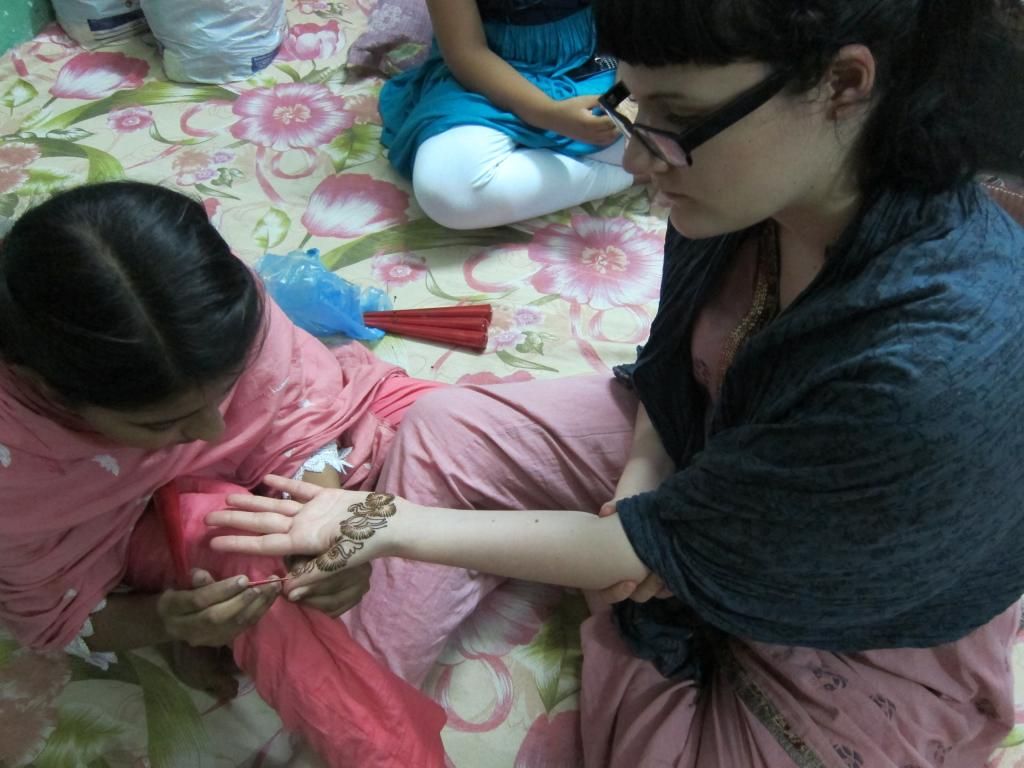
getting my home made mehndi
Apart from the sleeping and obviously ill boy on the cushion, there was no other man we could ask to get the henna. After some hesitation, the old woman said she would go out and buy it. The sister gave her rupees, and I watched as the woman covered her bright orange kameez with a black abaya, clearly the only abaya she owned, and tied a black scarf around her head and face.
Alone in the stranger’s house  I took time to carefully observe my surroundings. The walls were two-toned, a dark sea green from the floor to the middle of the wall, and a mint green from the middle to the ceiling. Illuminated green Christmas lights were tacked to wall, spelling out the word “happy” in English. Below a plastic streamer taped to the wall seemed to spell out the word “I'm” but the sentence was left unfinished. On another wall hung a faded blue picture of the hajj, a sign that we were in the home of a Muslim family.  Opposite the hajj picture, was a shelf with an old box television. In the corner of the room, tucked away in a small alcove, was an ancient sewing machine. A black iron beast from the industrial age.  There was nothing else in the room. The floors were concrete, like the walls, but there were no carpets or rungs, only a floral sheet separated us from the concrete floor.
I asked the sister about the dwelling, mistakenly thinking that the entire compound belonged to them. I was then told that this compound was shared by many families. Each family had one room with only a curtain door, but there could be as many as six people in that room. We were not sure how many people were in this woman’s family, but the sister was fairly certain that the sleeping boy and the two young girls also lived in this one room. The kitchen and washrooms were shared by all the residents in the dwelling. 
Though we had an abundance of time and awkward silence, I didn’t ask any more questions or talk about things in the room. I wondered where they prepared meals, where and how they ate them, how they took baths or used the washroom. I wondered about many things in their daily lives, but I didn’t ask any more questions. The sleeping boy hadn’t stirred a bit since we arrived, and the girls kept their gazes low in deference.
Nearly an hour passed since the woman left. We began to worry after thirty minutes, but I could not decipher the source of concern from the sister or cousins. Were they worried that the lady encountered some dangers on the dark streets of Karachi? Or were they just annoyed that she took so long, and worried about their henna designs?
Just as these thoughts were floating around in my hear, the women returned with two bottles of henna. They were about 30 rupees (or 30 cents) each.
She called the girls over, and the three of them began to do our henna in a rush. One girl did my hands while the woman and another girl did henna for the sister and one cousin. The other cousin said she would wait and do hers tomorrow, so she watched as we got our mehndi done.
The girl worked silently on my hands, showing no emotion and making no sound. I passed time by studying the embroidery on her kameez, and wondering how she spent her days when she was not applying mehndi to the hands of a foreigner.
The driver picked us up at 9:00 which was the time we had pre-arranged. In the end, we only had 45 minutes to get our mehndi done, which was not enough time for any elaborate design. After we returned to the house I was told not to wash my hands for 12 hours or even try to peel of the henna, but the feeling of dry henna on my skin, and that sickening earthy smell made my hands feel wretchedly dirty, so I ended up wiping it off within hours of returning home.
The girls were horrified when I came out of the bathroom with my orange hands.
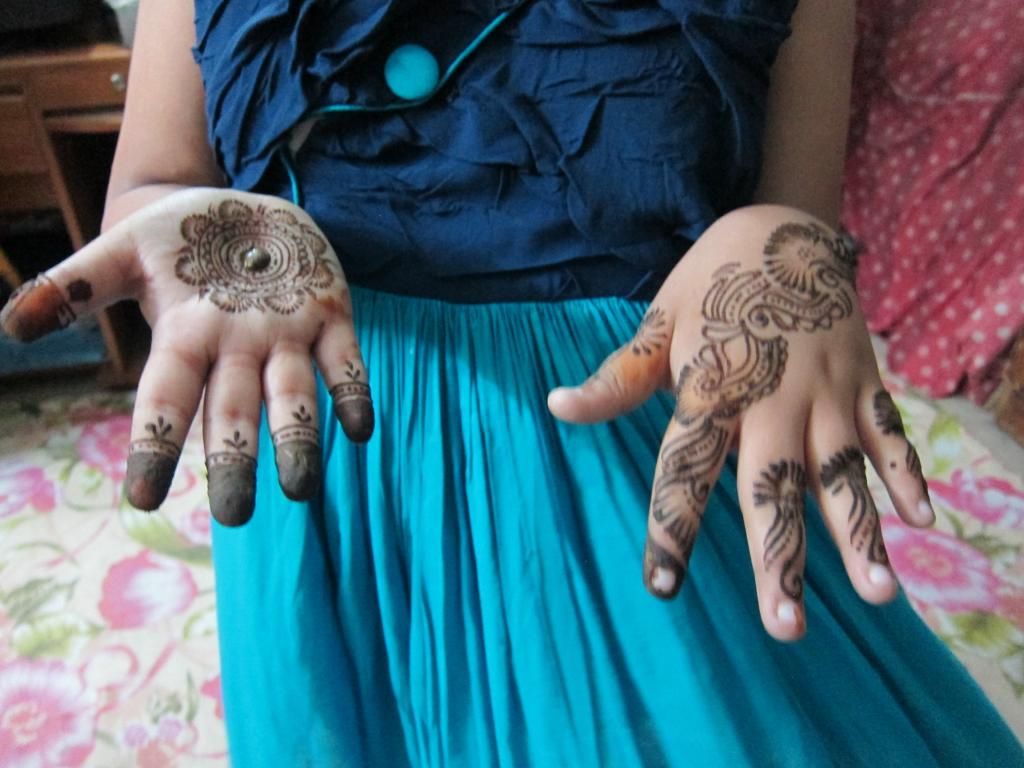
The henna is supposed to turn deep red, but on my hands it was a light orange.
Ancient Ceremony, modern technology
“You’ve ruined it!” they exclaimed, but by morning the henna had turned dark orange, and by the following afternoon it was burnt orange. Although it was not as beautiful and the deep ruby color of the cousins henna, I was still pleased with my simple design.
Then, as if our day was not busy enough, I was told that we would perform the Tel ceremony before going to bed.
The Tel Baan is a small ritual that takes place in the home of the bride. Guests take turns gathering around a small shrine, dipping their fingers in oil, and rubbing it on the bride’s head. A priest was called to the house to perform the ritual, but we were all shocked to see how young and handsome the priest was. He could not have been over twenty-five years-old, with a checkered shirt a wide black rimmed glasses. He was the most modernly dressed of anyone in the room. During the Tel, one of the cousins called a relative on skype, and held the laptop next to the shrine and recorded the ceremony for the distant loved ones to see.
The ancient ceremony stood in stark contrast to the Skype screen.

Dinner was served at home, around 11:30 pm, and pots and plates were again passed around to the guests. When we finished eating, and finished talking, I again made it to bed well after midnight. 

Sunday, April 27, 2014

My Pakistan Diaries: Stranger at the Sangeet


In March of 2013, I was invited to attend a wedding in Pakistan. I spent two  weeks in Karachi, Hyderabad, Lahore, and Islamabad. This is the account of my real experience there.  Out of respect for the privacy of my friends, I have not named anyone, and I will not be posting pictures of their faces, or providing details which may reveal their identities or locations. Read more about my diaries here

Tuesday, March 26th, 2013 
Karachi, Pakistan

I woke up in the aqua room at 9:30am. Feeling that I must have slept in, I hurried out to the dining room to find only the bride and her mother had awoken. Everyone else was still sleeping soundly. The bride told me to go back to bed, said we would have a long night and I might as well sleep while I can. So I returned to bed, where the room was dark and hot, and the fan shredded the air above me at an alarming speed, so fast that I worried obsessively whether it would unhinge itself from the ceiling and descend on my sleeping person.
At around 10:30am it became impossible to sleep anymore. Already several relatives were awake and walking around the room as though I could sleep through noise like a cat, so I got up and took my turn at the queue for a shower. With only one bathroom and several women, planning a shower was like orchestrating a small production. As each girl got her turn the washroom became wetter and steamier. By the end of the day it was impossible to dry oneself without stepping outside the house.
Breakfast - as they called it  - was served at 11:30 am. It consisted of one roti, and one papar, which were eaten together by breaking off a piece of each with one's hands. I was dressed and ready to leave within an hour of waking up, and was told to hurry because we were leaving for the mall soon, however, when it became obvious that I was the only one making haste, I sat on the orange leather sofa and skyped with my family back home. As there was no private room for me to enter, I had that conversation while alternating between the orange couch in the living room and the balcony, where the children were not too loud and the adults were not too mischievous. The very idea of having a private conversation in this circumstance did not seem achievable, so I settled with a semi-private conversation, which involved me speaking to only one person in a crowded room full of curious onlookers.
Just after 12:30 five of the girls got into the white car with the mustachioed driver, and in what is typical of Pakistani fashion, took the longest and circuitous route to the mall. We dropped off the youngest sister at the bazaar, where she would run errands alone. When I saw that little girl get out of the car and enter the dark alley on her own I felt a sense of panic, as though it was the last time I would see her. Then I realized why crimes are so terrible, because nobody expects them. No one would expect the youngest sister of the bride to go missing in a crowded bazaar. Pakistanis, even knowing they live with the treat of constant danger, never expect this sort of thing. I watched her disappear into the crumbling walls as our car sped off to the mall. 
Karachi's nicest mall 
When one pulls into the Karachi mall the first order to business is to be escorted to the entrance. Uniformed guards open the passenger doors like valet. They never open the driver’s door, because he is a driver, after all, not a customer. This would feel like an elaborate service, if it were not for the fact that the uniformed men carry rifles. The entrance is only a few feet away from the circular driveway, where more armed guards carry rifles and hold the door open for us as we walk in. Inside the building, women and men separate to either side, put their purses and possessions on an x-ray belt, walk through a metal detector, and pick them up on the other side. After that step through the security checkpoint the mall looks like a mall in any other country: shiny and cold consumer heaven. The food court is on the top floor, like the malls in America. The center of the mall is an open atrium where one can see all levels. Most shops are jewelry, rug, or clothing stores. I was most interested in the clothing stores, but too shy to go in by myself. Perhaps because it felt so similar to home, or perhaps because of the elaborate security,  I felt safe in the mall. I felt like I could walk away alone and be fine, like I could enjoy a cup of coffee and not worry about how I was going to get through my day. The mall was far less crowded than the streets. Here no one stared at me or caused me to feel out of place. It was surreal to think that just outside the glittering walls men were riding donkeys and selling oranges from wheel barrels.
However, at the mall I did not have control over my time. We were on a hunt for a present for the groom. He wanted to a watch, and had given specific descriptions to the bride, yet in every shop it seemed they had a watch with the right color but wrong dimension, or the wrong color but right wrist band style. Nothing was exactly perfect. I followed the bride and her cousins around every store until I could no longer feign interest in men’s watches. 
While walking from one watch store to the other, I kept myself entertained with small talk. I learned that there is no Starbucks in Pakistan, but for some time they were considering opening a store, though the plan fell through. I learned that this mall, the Dolmen Mall, was the newest and finest mall in Karachi, and I believed it. After the resolution that our watch journey would not conclude successfully, we wondered into a clothing shop and I felt instantly at home. Thankfully I fit into a size large at most stores, and that I could generally afford local designer brands from boutiques.
By the time we returned home it was well past 3:00 o’clock, but lunch was waiting all the same. The older relatives had already eaten, so I was left with the morning’s rotis, and some delicious vegetable curry. After eating I was told to take a nap. Although I had slept in late, the heat of the day exhausted me, and I knew we would be having a late night. Besides, there was nothing much for me to do but sit on the orange leather couch and watch others watch me, so I was thankful for the opportunity to pass some time.
Around 5:00 the cousin came into my dark room and said that it was time to get ready. I was already awake because the siring of voices had elevated in the last hour, so I knew intuitively that more guests had arrived and that the women were anxiously preparing for the ceremony. Although we all had our outfits planned, it took over one hour to get changed, as there was only one bathroom for six girls, and much time was spent queuing in front of the mirror or waiting for the toilet. This was my first experience with the way Pakistani women get ready. Everything takes longer than imagined. 
Although I had initially tied my satin orange sari by myself, the women laughed at my poor attempt, and one cousin - whose school uniform is a navy blue saree - re-draped mine to perfection. The pleats on my should were crisp, and the skirt was wrapped around my waist, tight like a doll. I felt beautiful.
Stairway to the roof
Tonight's ceremony was the Sangeet, and it was being held on the roof of their apartment. When all the women had finished adorning themselves, we went outside and climbed the white concrete stairs towards the roof. A flashback came to my mind and I was at once transported back to Puerto Vallarta, where the white stairs of my hotel room glistened in the Mexican sun. But this was Karachi. The sun was already below the horizon, but the white stairs, embellished with red rose petals, evoked the same magical feeling.
On the roof, the stairs lead not to an open platform, but to a door with enclosed walls like a room in a Pakistani home, only the sky was the ceiling. A long white hallway stretched out before me, obscured by hundreds of shoes that clung to the sides of the wall. Beyond the hallway was another door, and I could hear a lively chanting from the other side. I removed my shoes and lay them on top of the pile of others that had accumulated, uncertain of how anyone would be able to match with the right pair of shoes a the end of the night. The door opened revealed a sea of women glowing in yellow light, their black hair,  bright smiles and colorful clothing radiated joy against a back drop of the Karachi night sky.
Walls of yellow cloth had been erected around the perimeter of the balcony to enclose the guests in a private space. Apart from the womens’ black hair, all other colors in view were bursting with brilliance. Reds, golds, oranges, and blues.
They clapped in unison as a group of women near the stage chanted a tune, reminiscent of a folk dance. As I tiptoed around the sitting women, following the bride towards the stage, her mother pulled me by the arm and placed me at the seat right next to her on the stage. I kept refusing, partly out of the humility as I knew that sitting on a chair on stage was an honor, and partly out of embarrassment: I wanted to blend in with the crowd of black-haired women, not be on a pedestal for all to observe me. At her insistence, I sat on the stage and was horrified to see that the only other two women on the stage were the bride’s mother and grandmother. Surely I was not deserving of such an honored seat. I immediately felt shame that I was sitting on a chair when not even the bride herself was. However, I couldn’t very well get up and sit on the floor, so I smiled shyly and clapped my hands in unison with the women. 
Sangeet at dusk
When I felt no one was watching, I whispered in the bride’s ear, Who are these women?”
“I have no idea,” she laughed.
The chanting soon subsided into one woman singing. She was reading from an old, wrinkled leaflet. I guessed it was a traditional wedding song, and that the leaflet was probably only brought out and used for such occasions. It was a long song, lasting almost a half hour. Somehow, the other women knew which parts to sing along in, and which parts were meant to be unaccompanied. I was given a tambourine, and I watched closely at the other tambourine-holder for the cue to start playing.
When the songs ended, the plays began. The play consisted of four middle-aged women, acting in the same tiny spaces they were sitting, with props of only hats, jackets, and brooms. Though I could understand nothing of the language being spoken, I noticed that two women were dressed in manly clothes, their voices lowered, and their demeanor masculine. They were playing male roles in the play, while the other two woman held brooms and pans, playing the same roles they held in real life, as wives and mothers. I couldn’t help but thinking how, with my western eyes, instead of seeing a wedding ritual that predates modern history, I saw it a drag show instead.
The colorful ceremony concluded with dancing. The melody was the same one to which we were greeted in the beginning. First the women in the play, who were obviously veterans of such wedding festivities, got up and danced. They held hands and bounced their hips from side to side. If there was room, they would make a circle. The bride joined in, then brought her sisters and cousins into the circle. Sure enough I was pulled in as well, though I felt self-conscience dancing while so many strangers sat around me.
Women at the sangeet
When the ceremony ended, the bride and her family remained on the roof while the other women left in a slow moving herd to collect their shoes and be taken to their house for dinner. When the rooftop cleared I could see the floor for the first time. It was decorated with exquisitely beautiful rugs. Along the edges of the wall I also noticed ornate purple chairs had been placed to accommodate women who could not sit on the floor.  Suddenly being greeted with a burst of free space, the cousins and I eagerly walked around and photographed each other in our Sangeet ensembles. We posed against the tapestry backdrop in pairs, singles, and large groups.
When the photographing commenced, the bride suggested that we all go to the panipuri cart for dinner. The guests had eaten most of the food already, so it was best that we family members find a meal on our own. Although I loved the delicious home cooking, I was so excited at the prospect of eating outside the house. What started as the journey of the bride and a few people, quickly turned into 16 siblings and cousins driving three cars to the panipuri place.
I rode in the car with the second eldest sister, and I learned that driving in Karachi did not have to be as terrifying as the family driver led me to belive. The road from her house to the pani puri cart was unlit and unpaved. The darkness was only penetrated by our headlights, and an occasional small fire of burning trash in the distance. Lone men would walk grimly on the sides of the roads. I could understand clearly why a woman would not want to be walking along these roads in the darkness of night. As soon as we parked at the cart, a young girl of six or seven approached our car asking for change. She was persistent and would not leave the group until finally one of the bride’s older male cousins shoed her away like a street animal.
the pani puri cart
When the men at the pani puri cart saw our large group, they hurried to put tables and chairs together. The result was a long, uneven concoction of plastic tables of different heights. On the uneven ground some of the tables were slanted and wobbled, but no one seemed to notice. We were sequestered in our own little dark enclave, surrounded by tall buildings, and shielded from the street by the panipuri cart. The menu was hand-written on paper, which had the wrinkled texture of being wet and dried many times. Not one item on the menu was more than $1. I ordered the cheekoo shake, because I had never heard of a cheekoo. The bride ordered orange juice was squeezed fresh and served with a hint of salt. Our drinks were served to us in huge glass pitchers, while the food arrived within minutes on thin paper plates. Many orders of pani puri and chaat were passed around. We shared every dish, though there was enough for each person to have their own.
The alley was so dark I could scarcely make out the faces of my friends. We ranged in age from ten to thiry-one. Men and women. Most of us - except me - where close relatives of the bride. I had been using the words “them” and “they” the whole time in Pakistan, forever secluding myself from the inner circle of the people I encountered. 
But for that moment, the word “us” seemed more appropriate than any other.

We returned from the pani puri cart around 10:30pm, but it was not time for bed yet. The sisters were busy rehearsing their dances for the mehndi, and I stayed up dancing with them for a little exercise. Sleep did not come until past 1:30 am

Leopard nights

Bought this leopard coat at a thrift store in LA about 8 years ago. I loved it when I found it - I had been looking for that exact coat for ...