Showing posts with label Journey to Izumo. Show all posts

Wednesday, February 6, 2013

Journey to Izumo: The Taisha

We have arrived

The journey to Japan's oldest and most famous shrine  actually began in 2009, when I was enrolled in a college course on Japanese culture. My professor was a Japanese woman with an exceedingly rare 5-syllable family name. She also grew up in Shimane prefecture, a place she described as being so rural that even some Japanese people can't find it on a map. "Eh? Shimane ken?"

I had a similar experience when I went to Ehime-ken (prefecture) on the island of Shikoku. No Japanese friend of mine could seem to say the word "Ehime" without adding a question mark to the end of it.

Anyway, back to Izumo. So, my professor described growing up in the lovely and rural Shimane prefecture which lines the northwest coast on Honshu (the main island), just opposite the more famous Hiroshima prefecture (which contains, not surprisingly, Hiroshima city). Shimane, despite being so very close to one of the most famous regions of Japan, is surprisingly lacking of tourists, both foreign and Japanese. I saw not one non-Asian person in all of my time in Shimane...which was only three days but hey.

a pond at the Taisha

So this professor of mine, wih the 5-syllable family name, apparently grew up in this little-known town called Izumo. One day in class, she casually mentioned a small detail about her home town, and this little speech marks the exact moment of the start of my journey.

Izumo city is home to the Izumo Taisha, one of the oldest shrine's in  Japan. All shinto shrines in Japan house a god. The gods all have designations, like god of war, god of the sea, god of wisdom, etc. 

The god at Izumo Taisha happens to be the god of marriage.

For this reason, many people, both single and newly married, make the pilgrimage to Izumo to wish for a partner and successful marriage. 

Hand washing before entering the shrine

The other interesting thing about Izumo Taisha is that it is the host of the annual god-conference.
That's right, a god-conference. 
That's when all the gods  in Japan leave their home shrines and take a business trip to Izumo, where they stay for a number of days and have their yearly meeting.

This time was known as Kannazuki, "the month without gods," in the ancient Japanese calendar, which falls approximately at the time of late October/early November.
Interestingly enough, in Izumo this same month is not known as Kannazuki, but Kamiarizuki, "the month when gods are present."

When I heard this story I made up my mind that I would go to Izumo during Kamiarizuki.
I wanted to make the pilgrimage to wish for love in the presence of 8 millions gods.
I wanted all the gods to hear my wish.

I wore my leather jacket for the gods that day
 
Now, I'm not a superstitious woman, but I figured that if I hedge my bets right something good is bound to happen.
Let's say the god at Izumo is too busy to deal with my wish, well, I just sent the request to 8 million of his buddies, so someone has got to come through.


people take turns making their wishes

Some interesting facts about Shinto shrines:

At most shinto shrines, it is customary for one to step up in front of the shrine, (throw in a bit of money), and clap twice to awaken the god(s).
At Izumo, a person must clap four times, instead of twice.
Two times for oneself.
Two times for one's current or future partner.

Also, when you approach the shrine itself, don't expect to see some ornate sculpture or elaborate image of the god (-that's Taoism). At a Shinto shrine you are greeted only with the image of an opaque bamboo screen. The god is supposedly on the other side of the screen, but you can't see him. Instead, you are supposed to envision whatever you envision. It is meant to be a personal interpretation of the god. You decide what is on the other side of the screen.

Shrine attendant sneaks into a back entrance

At shrines you can also pay a small amount of money to receive an Omikuji, or fortune. If the fortune is good, you keep it and take it with you. If the fortune is bad, you tie it to a fence or tree, and leave it in the shrine.

Although I read Japanese, I had a lot of difficulty interpreting my fortune. This can mean that either the Omikuji is written in an eloquant but abstract way, or that I'm just a little dumb.
After reading it, (and thinking it was bad), I asked one of the shrine attendants  to confirm if it was bad. She said it was, so I tied it to the fence

my omikuji

one of those is mine

The final part of the process, after making your offering to the gods, and receiving your omikuji, is to make your ema, which is your wish. The ema are small wooden plaques that you buy and then promptly leave at the shrine, never to see again. This is the way the gods receive your message.

I bought the ema for good marriage, and I wrote a bilingual wish on it, in Japanese and English. Japanese because the gods are Japanese, and English because my Japanese sucks.  

After I hung up my ema some people people came to look at it and said they never saw a bilingual ema before. 
They also said they didn't think the gods spoke English. 
I told them that surely the gods know English, because you can't underestimate the gods' ability to adapt to the fast-paced changes of globalization.
Except that I don't know how to say any of that in Japanese.
So I smiled and nodded. 

the marriage ema

my bilingual wish


From a classroom in Portland to the coast of Honshu, if it was not for a certain professor and her life story, I would never have even thought to visit the Izumo Taisha. Funny how things happen like that. The circumstances made this trip so much more special than if I had just picked the destination out of a travel book.

Let's conclude with a recap from start to finish:
  1. Plane ride from Portland to Tokyo: 
    1. 11 hours
    2. no cost (I had frequent flier miles, but otherwise about $1,000)
  2. Overnight train ride from Tokyo to Izumo city
    1. 12 hours
    2. no cost (I used a JR Rail pass, but otherwise about $130)
  3. Trolley from Izumo city to Izumo Taisha-mae station
    1. 20 minutes
    2. about $5
  4. Walk from Izumo Taisha-mae station to Izumo Taisha: 
    1. 15 minutes
    2. no cost (unless you buy the sweet kinako mochi form the old couple on the street - $3) 
  5. Getting to make my marriage wish in front of 8 million gods. 
    1. Totally. Fucking. Worth. It. 


Wednesday, January 16, 2013

Journey to Izumo: The walk

After leaving Izumotaisha-Mae station you are faced not with the Izumo Taisha itself, but with a long road stretching in two directions.
And which direction is the Taisha? 
To the right.
And what happens if you go to the left?
You come across a strange rock sculpture. 

But you probably didn't go all this way to see the sculpture (though it is interesting), you can here to see the Taisha. So, to the Taisha we go.


The right direction

The street is lined with beautiful pine trees. In the distance you can see the deep forest green mountains. The Taisha is deep in those woods, about a 15 minutes walk away. So long of a walk in fact, that we were often wondering if we were indeed going in the right direction. 


To keep one entertained, there are many interesting sights along the way. For example, observe this mysterious and elusive night club called, "Live" (pronounced like "live show" not the verb "to live"). So the Japanese indicates that this is a "snack bar," which is like a hostess bar, but less expensive...and with snacks. Snack bars are apparently all you have to choose from for adult entertainment in the countryside.


check out this guy, walking suspiciously out of "live"

Just before the shrine, we met  an old man and woman making Kinako mochi on the side of the street. Thinking this opportunity was too rare to pass up, I bought some, and stuffed it in my mouth while walking obtrusively along the street
. (In Japan, it is a  huge cultural faux pas to eat while walking). 


waiting in line for mochi

I never ceased to be amused by the sights of rural Japan. Even this shanty alley holds some kind of mysterious appeal to me.


a random ally

After we ate our mochi and walked up a steep hill, we turned around to snap this photo. The station is just in front of the white gate (on the left), and the mochi stand is directly off to the left (where you see the purple banner), to give you an idea of the distance. 


the view from atop the hill

Along the way we passed a strange residence. 

 I was sort of fascinated by this random house. There are almost no windows, and the driveway is enormous! What is anyone going to do with all that gravel? Seems odd to me. That strange house almost made me forget about Izumo Taisha. Well, you know you are close when you pass this house.


a random house with a large gravel front yard

Finally we've reached the entrance to the Taisha! Too bad there was a lot of construction going on when we were there. It kind of detracted from its ancient look. Oh well...


you've made it!

Monday, January 7, 2013

Journey to Izumo: Izumotaisha-mae Station

After a 20 minute trolley ride from Izumoshi Station through Japan's scenic rural countryside, one is greeted at IzumoTaisha-Mae station by this lonely sign.


As I may have mentioned, IzumoTaisha-Mae literally means, "in front of Izumo Taisha." This led me to believe that the station would literally be right in front of the Taisha (shrine)

I was a bit off in that assumption. 

The Taisha is another 15 minute walk from the station. There are no clear signs to point the way (but there may be some not-so-clear signs), however upon exiting the station there is only one main road, so after glancing both ways, you have a 50% chance of guessing the direction correctly.


The arched ceilings and stained glass windows of the station reminded me of an old country church. The benches inside the station all faced the same direction, like rows of pews. I had wondered if in fact it was an old church that had been remodeled into a station, but alas, it is just an old western-style station. 


Don't be fooled by the "Information" sign in English. There was no English to be found in this neck of  the woods.


When we left the station, we actually guessed the right direction to the Taisha the first time, but we decided to take "the path less traveled" and see what was at the other end of  the road as well. We came across this large gate, and a very interesting stone sculpture.


Wednesday, January 2, 2013

Journey to Izumo: The Trolley

After our meal at Izumoshi Station, I decided the check the times for the trolley that leave for Izumo-taisha-mae station. When I approached the trolly stand, I was surprised to see it unstaffed, with only an old rusty ticket machine.

Apparently the trolly leaves only a few times a day, and we still had another hour to kill before the next departure. I bought my ticket and went to shop at the station's mini-mall, which consisted of a rock quarry, a man-made indoor pond, and about 8 shops. We were among the only people in the train station the whole time. The scene was terrible depressing, but somehow I was charmed by it.

Our classy ride

The trolly to Izumo is a tiny version of a train that shuffles passengers from the main hub of Izumo station, to the truly rural parts of Izumo.

The train itself looks to be from the 1960s or 70s. In fact, it is sort of charming that they haven't updated it in all these years. Why would they? There were barely any passengers when we were there.

Instead of the elaborate kaisatsuguchi (ticket gates) in the train stations fo Tokyo and Osaka, to board the Izumo trolly all you do is show your ticket to the man at the window, who only appears 15  minutes before the train departs, and promptly disappears afterwards. With only a few departures a day, it's hard to justify why he would need to work more.

Because we didn't want to haul our luggage with us to the Taisha, we checked into into a locker at Izumoshi stations. I had also, foolishly, hidden my umbrella on top of the locker, way out-of-sight from anyone, and yet somehow, when we returned, it vanished. It remains forever in Izumo


Looks totally legit


my friend just doing his thing

Along the way are many wonderful sights of the countryside. Rice fields, old Japanese rooftops. It was a gloomy day, the skies were streaked with grey and rain was falling intermittently. 


The train line is known as the Kita-matsue Line. After about 10 minutes of riding on the red velvet seats, who come to Kawato station, where everyone dismounts the trains, and boards an identical train for the Taisha  Line. Another ten minutes, go by, and you arrive at Izumo-Taisha-mae station, which  is appropriately named, "In front of Izumo Taisha" station.


Waiting to change train lines

View from the window 


Friday, December 28, 2012

Journey to Izumo: Izumoshi Station

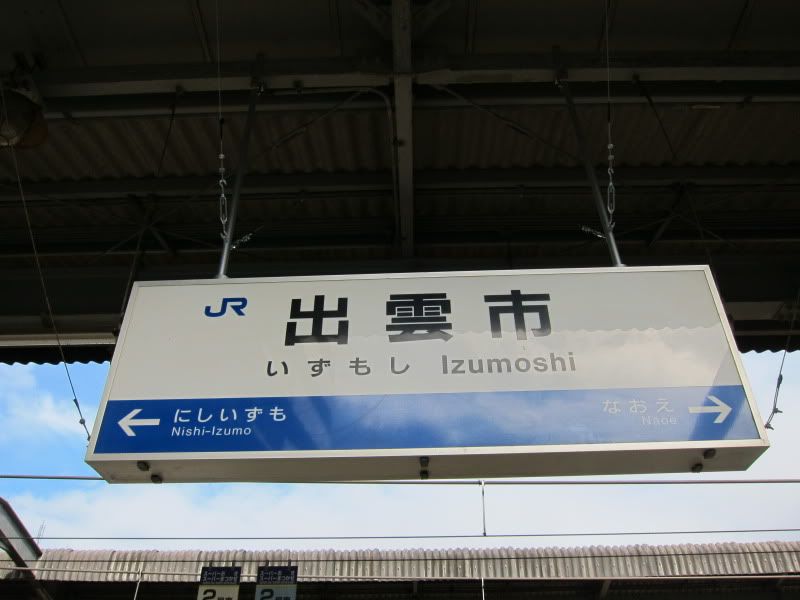
 Izumoshi station is the last stop on the Sunrise Izumo, a 12-hour overnight train ride from Tokyo. Though the train had been making stops throughout the night, when we awoke around 7:00 a.m., our cabin was still crowded with people. Slowly, however, with each stop they became less and less, until we arrived at Izumo, and we were the only ones left. Being the last people to depart the train left us feeling strangely out of place. Like we overslept our real exit and we were now getting off in some no-man's land.

Sure enough though, the Izumoshi Station sign greeted up upon descent.


This marked the end of the only night I ever spent on a train in Japan. Usually I'd be at in a hotel, or a friend's house, or ever bar-hopping all night. Standing on the train station platform made me realize how unbelievable hungry I was. After sleeping on a floor for 12 hours, I decided to celebrate with my favorite Pancake drink from a vending machine. 

God how I love the pancake drink. It literally tastes like  pancake in a can. Imagine a milk tea, but with a slight buttery-maple-syrupy flavor to it. 

Yeah man


I am not fucking kidding


This was my very first time in what I am going to call, "deep Inaka." Inaka is the Japanese work for: rural, countryside, sticks, boonies, BFE. It has a slight derogatory connotation to it, but it can be used affectionately. Americans may confuse this term, however, with our own perception of the rural countryside. Mind you, Japan is a very crowded country, so any town with a population under 2 million is considered Inaka. There is no Pawnee-Texas-population-202-type town in Japan. Basically, a place can be crowded, and still be inaka. Also, one last misconception. Just because a place is inaka, doesn't mean it is without modern technology. Get rid of those rural-China-ox-cart-farming images. You won't see anything like that in Japan's inaka. Rather, imagine something like a sprawling suburb, with no McDonalds and no Starbucks. Welcome to inaka.

Now, "deep" inaka is my term for a place which is really really inaka, but also really far from any major city. People joke that the town of Chiba is inaka, but Chiba is only a 45-minute train ride from Tokyo. Izumo is 12 hours. The closest city is probably Matsue, but there are not many world-famous destinations on Japan's northwest coast. Hiroshima, Osaka, Nagoya, and Tokyo are all along the southeast coast. 

The street right outside Izumoshi station


Landscaping around the station

Despite being "deep inaka," Izumoshi station is pretty big, and even has a little shopping center. I enjoyed a nice meal of  Oyako Don at the soba restaurant there. We were the only customers, and the waitress was an old women who was probably also the shop owner. 

Oyako Don, rice, tea, pickles

The thing I really like about inaka is that people kind of expect you to speak Japanese. Maybe they figure that you've made it this far, so you probably know enough to get by. Usually they are right. The fact that I speak Japanese is kind of taken for granted in inaka. Feels great. 
 
Don't judge. You'd look the same if you had slept on a train floor for 12 hours.

Sunday, March 25, 2012

Journey to Izumo: Aboard the Sunrise Izumo


The man at the ticket counter does not want  to sell me this ticket. 

“You do realize that you’re going to be sleeping on the floor?” he says. 

Yes, I know exactly what I am getting into, I assure him. I am reserving a ticket on the overnight train from Tokyo to Izumo city. It’s called the Sunrise Izumo. The train departs promtpy at 10:00 pm from Tokyo station, and twelve hours later you find yourself on the southwest coast of Japan, just before 10:00 am.

 With a Japan Rail Pass, this wonderful journey is completely free…if you sleep on the floor. The alternative is not much better: pay almost $120 for a private room with a twin-sized bed. That’s more than most budget hotels in Tokyo. 

I’m going to suck it up and become one with the floor for twelve hours, but the man at the ticket counter doesn’t believe me. Listen buddy, I’ve slept in far worse places than the floor of a train, but I won’t get into those stories here.

“No bed,” he says, “twelve hours with no bed.”

Maybe they’ve had problems with foreigners before. Like, the ticket man tells them that they will be sleeping on the floor, and then they board the train and are shocked to find that they will be sleeping on the floor. 

Somehow, after five minutes of bilingual negotiation, he hands over two tickets for two spaces on the floor of the Sunrise Izumo. What a relief. I had to fight hard to get these tickets, not just with the ticket man, but the whole reservation system. When taking overnight trains in Japan, you absolutely must have a reservation. However, it is impossible to make this reservation outside of Japan, especially if you are using a rail pass. The night trains are also popular, and almost always get full. Therefore, if you plan to take an overnight train the day after you arrive in Japan, it means you better hope and pray that there are still spaces available, but very likely there are not. We got lucky, my friend and I. We booked the last two spaces two days before we planned to leave.


Back in Tokyo, we’re waiting on the platform for the Sunrise Izumo to appear. There is a group of very cute twenty-somethings next too us, and for a brief moment we hope to share a space on the floor next to them, but alas, they continue on to the next platform, and are replaced with a group of old, drunk businessmen. Then I remember the final, foreshadowing words of a Japanese friend, just before we departed.

“Watch out for those old perves on the train. The men like to get really drunk before taking the night train.”

Don’t want this to turn into an all-night touch fest. I motion to Danny that he better be on his guard. At this point, I’m getting kind of nervous. I mean, I know we’re sleeping on the floor, but how bad can it be? Before we left I tried relentlessly to look up pictures of the Sunrise Izumo, so I could get a good idea of the interior, but I couldn't find much at all. I was about to board terra incognita.


  -->

The train pulls in, and it is immediately obvious that this is one old piece of machinery. I guess after taking some many Shinkansen, your expectation is that everything in Japan must be shiny, new, and extremely fast. This tin box is probably older than me.
The doors open, and we board.


Finally, the interior of the  Sunrise Izumo is revealed!


The train car is divided into two levels, like giant bunk beds. The floor is partitioned into individual-sized sections, with very little privacy. At least the touching perameters have been established.

Danny and I thought this ominous black lens was a (not-so-hidden) hidden camera, put in place to monitor any unauthorized touching. But it turned out to be a reading light. God we are so paranoid. 


The partitions are  wide enough to say, “this is my space, jerk,” but not wide enough to allow for any amount of privacy. The only way to escape from being within inches of a total stranger in the small window in each cubicle, which allows for a private view of the outside.


As soon as the train departs, it becomes obvious yet again that this is no Shinkansen. The train vibrates heavily and sways from side-to-side like a sinister baby cradle. Its going to be a long night.


Thank god I'm a light packer. Any more luggage and I wouldn't be able to fit my body in here....


My fellow floor-mates were quite the disciplined bunch. They went to sleep effortlessly as soon as our tickets were checked, and they made no noise or fuss about anything. When I  awoke around 8:00 am they were all dressed and staring out their little windows, which made me feel like a teenager waking up on the couch of a friend’s house....
 
The sunlight was glorious that morning...


Since I had woken up earlier than expected, we had an hour to kill before arriving. We decided to wonder around the train and check out what we had been missing...


Leopard nights

Bought this leopard coat at a thrift store in LA about 8 years ago. I loved it when I found it - I had been looking for that exact coat for ...