Monday, May 12, 2014

My Pakistan Diaries: Memoirs of a Hindu Wedding


the author with an unknown child

In March of 2013, I was invited to attend a wedding in Pakistan. I spent two  weeks in Karachi, Hyderabad, Lahore, and Islamabad. This is the account of my real experience there.  Out of respect for the privacy of my friends, I have not named anyone, and I will not be posting pictures of their faces, or providing details which may reveal their identities or locations. Read more about my diaries here

Friday, March 29th, 2013 
Hyderabad, Pakistan


At 1:30 pm I awoke calmly to the sounds of people chatting around me. I was one of only a few women still sleeping on the floor. The pillows and blankets were still lying around the room in disheveled positions, but only a few sluggish bodies broke the expanse of carpet like sand dunes across the desert.
On the large blue couch a few cousins were chatting.  Lunch was handed to me around 2:00 pm on a paper plate. It was basically the same food I had at the bride’s house, only more oily, and not as flavorful. Looking to escape the musty house, I ate outside, sitting on the edge of a concrete wall. The power had gone out just before I made it to the courtyard, and the dining room was so dark I could not see the food on my plate.  I still had not fully digested the banquet feast from the wedding, so I ate very little of what was served to me, and tried to hide the rest so that my hosts would not be offended. At this point I was getting very sick of rottis, and I missed rice, like the kind I had eaten at the wedding. As usual, I ate with my hands and there was nothing to clean them with.
Naively, I asked the bride’s Indian cousins where we would be going today. Somehow I assumed that I could spend the day exploring Hyderabad, since I didn’t expect to start getting ready for the wedding until 8:00 pm, and showing up at 10:00pm or 11:00pm like yesterday. They replied that today would be spent preparing for the wedding. I asked what they meant by that, and they gave me the same answer. Getting ready.
“All day?” I asked.
“Yes, we’ll stay here and get ready all day.”
 I was displeased at this prospect. I wanted to be outside, I wanted to be anonymous in a group of people. I wanted to go shopping. I wanted to eat at a restaurant. I wanted to be free. I was tired of having my time controlled and yet having no idea what was going on. I didn’t know how I was expected to spend a day “getting ready.” I was annoyed by the heat, the hard floors, the frequent power outages which turned off even the fans, and my general lack of clarity in every situation.
I went back into the large room where we slept on the floor. The blankets and pillow had been collected and were neatly folded and stacked near the wall. I sat on the blue couch and took out my writing pad.
I  was running out of ways to occupy myself in the house, where I was never alone, never without noise, never without heat. So my writing was more an a rant. In the room opposite to me the small children banged the walls with a rocking chair, laughing louder each time they do it. Just across from me, in a relatively more quiet room, a woman ironed her dress for tonight, deep blue fabric with gold embroidery that glistens like light on the ocean. Every now and then she looked back at me, unsure if she should speak or ignore me. Whereas the servants have been taught to ignore, family and guests have been taught to engage. Many times I found myself in the middle of a group of women and if I look away for even a moment, disengage ever so briefly from the conversation, the questions rain down on me. Am I bored? Am I hungry? What am I thinking? What do I want to do? They look so hard for ways to keep me entertained and engaged, when all I want to do is retreat. 
I felt grateful to be so cared for, but I longed for independence.
I was not in control of my fate. I knew it would be this way. Everything is a group effort. We talk about stepping out of the house long in advance and then hours or days of planning ensues. Nothing is spontaneous. Yet, nothing is so meticulously planned either. Each time we leave, I don't know who is coming with us, where we will go, or how long we will stay out. Perhaps this is because the plans of so many people are involved, so they all get tossed together in a giant cluster of activity. I can only accept it. And wait.
I sat there writing until around 4:00pm. Within an hour I was called in for dinner, which I considered lunch, since we would be having another feast at the actual wedding. It was the same food I had eaten earlier, so I ate even less of it.
Afterwards we went into the bathroom, the only bathroom in the house, and poured water on the bride’s head. This was another wedding day ritual. The bride squatted on the bathroom floor and the woman gathered around and drenched her with stone pitchers of water.
The streets of Hyderabad at dusk
When the cousins asked if I wanted to go with them to the parlour to get ready, I jumped at the opportunity. It was my only chance to get out of the house. And I longed to be in a place with a public restroom that wasn’t being used by thirty women at once. Also, since we would be in the company of the bride, I knew that it would be impossible to be late for the wedding. The mustachioed driver took us to the parlor. Since the bride was dissatisfied with the parlour she attended yesterday, we would be going to a different place, somewhere that came at the recommendation of the groom’s brother’s fiancé. However, we didn’t know exactly where the place was. We had an address, but when we arrived in the vicinity it proved difficult to find. We drove around block and block looking for it. Normally this would have annoyed me, but I was still elated at being outside the confines of the house. I was also enjoying the view of Hyderabad. Large estates lined the streets, each with walls and wire fences protecting them. In the yards of some manors, men in white trousers sat on the grass and looked into the distance. They were migrant workers, hoping to get picked up for a job.
On the road I saw a sculpture garden of animals, with tired people lounging on the zebra, elephant, and giraffe. While driving through the neighborhood of the parlour, I saw many large and gorgeous houses. They all looked like castles from an issue of Architectural Digest. Yet outside their walls the road was unpaved and piles of garbage stood taller than a person could climb.
Whenever our driver passed a pedestrian, he would roll down the window and ask him in Sindhi if he knew where to find the parlour. Each answer from a stranger got us closer and closer, until eventually we came to the right place. There was no sign, and it was impossible to see inside the building. It had an iron gate and thick wooden door. The façade was as decrepit as every other public building in the city, but inside it was modern and clean. Wooden floor boards lead the way to a modern bathroom, with toilet paper, a sink, and soap. I was in heaven.
I decide not to have my hair or make up done. I didn’t want to spend the money and I opted to do it myself. There was also a certain sense of pride I had in doing my own make up. Inside, the groom’s brother’s fiancé was already wearing her wedding dress and was nearly ready. Her make up was very dark and strong. She was a naturally beautiful woman, with elegant features. The bride was also told to put on her dress first. Apparently it was important for the staff to see the dress in order to decide on the hard and shades of makeup. Her cousins, who seemed to find themselves at home in a parlour, got to work right away telling the staff how to do their hair and make up. I sat in the entrance way, pulled out my notepad, and again started writing.

the bride's gorgeous dress

Around 8:30pm, about an hour after we arrived, I began the process of getting ready myself. I decided on an up-doo, bangs brushed to the side, with a tika. I had the cousin’s help again with my sari. And one by one the staff came out to take pictures with me. In my mind, I titled their photos, “a white girl comes to Hyderabad.” We took the photos on their phone cameras, old sad pieces of technology that I had long since discarded years ago.
We were all ready to leave around 10:00pm. The salon closed at 9:00 pm officially, but the staff seemed used to staying late to accommodate brides-to-be. They brought out their black abayas and covered their faces and heads with black scarves as we left the salon. They locked the door behind us and their black-clad bodies all but disappeared into the night.
That was when the bride made the most amazing statement I had heard since arriving to Pakistan.
It was odd and random, considering that she was about to get married, and about to have a feast in her honor, but we escorted the bejeweled bride into the car, and went through the McDonalds drive way. 
We ordered six extra sets of fries, for “everyone else” at the wedding. [Author’s note: I didn’t understand why at the time, but it would have been incredibly rude in Pakistani culture to pick up food for oneself and not for others.]
We arrived at the venue at 10:45. The wedding venue was outside, in a large, open patch of grass. Since it was a tented wedding, I envisioned a white plastic tent propped up over the dirt floor, so imagine my surprised when I walked into a room grander than yesterday’s ballroom. The white tent had cathedral like ceiling, from which hung crystal chandeliers. Blue and purple lights cultivated a chic atmosphere. The setting was definitely more akin to my image of a lavish reception, rather than a formal wedding venue.
entrance to the wedding tent
Like the Mehndi, there was a stage with two sets of cushions for the couples to pose for pictures. To the far right of the tent was a small square platform, covered in curtains of orange carnations. This was the stage where the actually ceremony would take place.
 There were hundreds of round tables and chairs, each covered with elegant linens, but now one was sitting. All the guests seemed to be walking around the tables, chatting and mingling. There would be no dancing at the wedding, so there was no performance for them to watch. Instead, they used this time to socialize. Worried that I would be left out and awkward, I snaked between the tables occupying myself with picture-taking. Yet, at just that moment I arrived I was approached by guests from all sides and asked to be photographed with them. They were all strangers to me, but they approached me with no hesitation and asked me to pose for portrait after portrait. I stood next to them, held their hands, held their crying babies. I was glad for the opportunity to have pictures with many women. I wanted to chronicle their dresses,  which were more modest and sophisticated than those I saw at the previous night’s Mehndi party.
I was the only woman in a sari.
A group of young boys from 5-8 years old perhaps, followed me around yellow, “Aunti-ji, Anuti-ji. One photo please.” How could I say no. We took the picture with my camera, since they did not have one. “How am I going to send this to you?” I asked. They boy found me again, running up with me like a pack of wild animals, with a pink cell phone in hand. It was the same type of old phone that the women in the salon had. We took a blurry group portrait with the phone, and they seemed happy.
As time passed, many guests lounged on the sofa and fabrics chairs, while others walked around the venue, going from group to group and making introductions and chatting with long time acquaintances. I spotted the jeweler there, the same man and his wife you had served me at the jewelry store in Karachi. They were apparently good friends of the family.
lavish dresses at the wedding
It was around this time that I noticed the tent was divided in half by an aisle way. I assumed that one half was for the grooms’ families and one half for the brides’ families, as in American weddings. However, it was only when the dinner buffet opened the I realized the tent was divided male and female. When I saw guests rush out of the tent to the courtyard, I followed suit, not realizing I was going out the men’s side. Apparently I'm so comfortable being in crowds of men that I am entirely unaware of it. The bride’s Australian sister-in-law stopped me and lead me over to the female side, as if I didn’t know better. I didn’t.
The outside space was divided more directly, with a small rope to partition the two sides. The buffet tables were identical, serving the same foods and deserts, the only difference was that there was a men’s side and women’s side. I thought this was strange because last night’s outdoor buffet was not segregated, but I was already finding myself more attached to the groups of women I met, and was thus not bothered to be separated from the men.
I did not make the same mistake as last night and load my plate up with everything. I already knew I liked the vegetarian dishes more than the meat, so I took one sample of every vegetarians dish, and left the meat alone. The evening’s desert was kulfee, a delicious ice cream which everyone seemed to flight over. The servers took out a large block of white ice cream, and cropped it into squares with a butcher knife. Then they handed it to us with bare hands. I had to fight for it. Women kept cutting in front of me a the table, and I felt ignored by the staff, but eventually a bare hand put a white block of kulfee on my paper plate and I could leave the madness of the ice cream table behind.
Later on in the night, I found the paper McDonald’s bag discarded in an ironic presence on the lavish rug, empty of food that was ravenously devoured by the guests.
Unlike the Mehndi, we ate dinner at midnight, before the ceremony began. Everyone kept saying the ceremony would begin late.
wedding banquet at midnight
I had to use the bathroom, and asked several women where I might find one. They all shook their heads with great concern. Port-a-potties had apparently been erected to serve the guests, but they were out in the field, amongst uncut grass and completely dark. I was also assured that there would be no toilet paper or water. Better to go back to the bungalow.
So at 12:30 am one of the male cousins drove me to the Bungalow to use the bathroom. Instead of entering the part of the house where I had been staying, he opened the door to a different wing, one I didn’t even know existed, and I used the lavish blue bathroom in that side of the house. That’s when I realized that I had been staying in the female section of the home. The men were all in this section. I hadn’t even realized that our living quarters had been segregated. But come to think if it, I didn’t ever see a man in our side of the house, and the bathroom I was sharing was always crowded because we were all women. I was stunned by my lack of awareness. Gender just didn’t play into my consciousness. I was unaware of a different in feeling whether I was a woman in a group of women, or a group of men.
He drove me back to the venue where the wedding had not even begun. I hung around outside by the parking lot, where one of bride’s younger male cousins wanted me to photograph him near the wedding car, decorated with paper carnations.
He puffed his chest out and planted post fists to each of his hips, like a tiny super man. He seemed so excited just to be photographed, even though he would never get to look at, or keep, the picture for himself.
When I returned from the restroom the tent had an entirely different feeling. What at first seemed so luxurious and glamorous now seemed muggy and humid. The heat of the night was descending upon us, and I only realized that moment that the tent was not air-conditioned. Mosquitos started finding their way in and I was having to swat them away. It was now close to 1:00am, the wedding of the groom’s older brother and his wife was already taking place, but no one seemed to know when my friend’s ceremony would be. I wondered around aimlessly, running out of ways to occupy myself. I had already taken photos with practically every guest at the wedding, eaten dinner, used the bathroom, and now I would have to wait however long for the actual ceremony.
the ceremony stage
At this time, I noticed that the crowds thinned significantly. One of the relatives told me that most guests just come for the food, and don’t even stay for the ceremony. Only close family stay for the ceremony.
Coke was the beverage served at the party, and in wonderful glass bottles with Urdu writing, so I decided to keep one empty bottle to take home with me. This proved quite difficult, as I could carry the coke bottle no further than a few feet without a gracious servant offering to relieve me of my empty bottle, or another guest trying to take it from me. I couldn’t explain that I wanted to keep an empty coke bottle, so I let them have it, circled the table, then picked it up again when they weren’t looking. This happened so many times that eventually I decided to just keep a full one with me. That way no one would think I was walking around with garbage.
Since I wasn’t wearing a watch, and there were no clocks to be found, time lost all meaning. When the Australian sister-in-law lead up onto the stage for my friend’s ceremony, I checked my iphone to see that it was 3:00 am. The power outages had been happening frequently after midnight. The groom’s older brother and new sister-in-law were lead to the opposite stage, where they were being photographed on the large white couch.
We were obviously well past our time limits for the reservation, because the movers had already come to disassemble the tent. I watched its entropy from begin a curtains of orange carnations. The chandeliers were holstered down. Fabric was being pulled off the tables and chairs, revealing their bare wooden legs. The purple lights that gave the tent its dream-like feeling were turned off and taken apart. The workers started by disassembling the buffet area, then working from the edges were there were no guests. The tent that could hold 2,000 people was now only covering about 200 close family members who had stayed to watch the ceremony.
The ceremony was conducted in Sanskit and nobody could understand the priest, so although we were onstage we talked loudly, laughed, and swatted flies away. We made funny faces and took pictures as if  the whole thing was a comedy. I was surprised by the irreverence shown at the ceremony, but everything in Pakistan had been so casual and irreverent up to this point, why not the actual ceremony? 
wedding ceremony at 4:00am
The ceremony finished at 4:45. I was watching my phones religiously at this point because I was tired and wanted to go home. At this point, everything had been taken down and disassembled except the stage we were one.
My newly-married friends posed for a few quick portraits on the white couch, which only had it’s backdrop remaining. Had the photographer pointed the camera in a different direction, he would have photographed an empty field in the pre-dawn hours.
As promised, a chocolate cake was served, but it looked nothing like an American wedding cake. It was a one-tier, rectangular cake with the names of each couple written in frosting. As with everything else it Pakistan, we ate the cake with our hands, this time with no knives or plates, just bare hands. I grabbed a piece for myself, although I was terribly full of food from the buffet, it seemed like a waste not to eat the wedding cake.
the bride and groom pose for pictures until morning
Out in the parking lot, as expected chaos ensued as no one seemed to know who would be riding home with whom. Eventually I got in a car with the bride’s parents, and pulled into the bungalow at 5:00 am. I got out of my saree and washed my face. That was all I could hope to go. Many of the guests had returned early, and were already asleep on the most desirable bedding on the floor. The couch was still unoccupied, so without hesitation or reserve, I laid my back on the couch. It was 5:30 am, I guessed. The ceiling fan was blowing at full speed, but the light was still on, so it was hard to sleep.
“Can we turn the light off?” I asked the bride’s youngest sister, who was lying somewhere amongst the crowd on the floor.
“I don’t know,” replied her sleepy voice. “Maybe we have to keep it on.”
And at just that moment, as though god had heard me, the power was cut. In the dark room, I could hear the ceiling fan slowly stopped revolving.
Sleep came to me in the still, dry heat.


Wednesday, May 7, 2014

My Pakistan Diaries: Mehndi at Midnight

In March of 2013, I was invited to attend a wedding in Pakistan. I spent two  weeks in Karachi, Hyderabad, Lahore, and Islamabad. This is the account of my real experience there.  Out of respect for the privacy of my friends, I have not named anyone, and I will not be posting pictures of their faces, or providing details which may reveal their identities or locations. Read more about my diaries here

Thursday, March 28th, 2013 
Karachi and Hyderabad, Pakistan

       On Thursday there was no time for sleeping in. I was awoke at 10:15am and told that we would be leaving soon for Hyderabad, the hometown of the groom and the site at which the wedding was to take place. A mere a three-hour drive away. I hurriedly packed and changed clothes, expecting to leave at any moment.
But instead of rushing, relatives lounged around the house, chatting calmly as usual. I was even told that we would probably have time to stop at the Dolmen mall before leaving (!!!????) I had asked the bride’s two cousins from India, to whom I had bonded with in the last few days, if I could come with them to the mall before leaving for Hyderabad. I had my eye on a red dress at a store there since the last time I visited, and I was hoping I would get the chance to buy it before leaving Karachi. Going to the mall involved gaining permission from their uncle as well as inviting other family members, and by the time they had done so, a trip in one car with three people again became three cars with fifteen people.
We did not arrive at the mall until 1:00 pm. First we dropped of the second eldest sister at the bazaar, where she would be running errands in preparation for the wedding,  then dropped off one cousin at Roses Parlour, where she would be getting her mehndi done.  
After we passed the security checkpoint at the Dolmen Mall, I told the girls I wanted to do some shopping on my own, and that I would meet them an hour later inside the mall. As I walked around the first floor, I spotted a foreign family at a café. These were the first foreigners I had seen since coming to Pakistan. I again was overwhelmed by the complete sense of safety I felt inside the mall, as it was so modern and reminded me so much of home. [Author’s note: As I read this now, the recent mall massacre in Nairobi is fresh on my mind. I am sure the shoppers and expats there felt completely safe as well. I am now struck by how false my sense of security was. Even in Pakistan, people expressed concern that I walked alone in the mall.]
Being alone for one hour of shopping was therapeutic for me. I finally got the red dress I had been eyeing, and as I headed up to the top floor food court to find juice, I saw the bride’s cousin. Without greeting me, she simply said, “Gloria Jean’s has a sea view!”
I had no idea what that meant, I thought she was talking about a person. But then she led me to the window of a beautiful cafe, with a remarkable terrace and view of the Karachi beach. At Gloria Jean’s café I finally ordered the latte that I didn’t know I had missed so much. But before I even had time to drink, the bride’s sister found us and suddenly we were in a rush to get back to the house. I stared at the couches longingly. How I wanted to relax and pass time writing on my laptop as I usually do. How I wanted to sit outside (though I noticed only men were sitting outside) and gaze at the harbor, but the driver was waiting for us. We took our drinks to go and hurried back to the car.

The house was in a far more chaotic state than when we had left. Luggage was strewn about in all corners of every room. Relatives were pacing from room to room, in an obvious rush to leave but somehow not being ready to do so.  We had only three cars and some twenty people who we needed to transport. Not all of us were present at the house, and of those present not all were ready to leave. The bride’s sister and cousin were still at Rose’s getting their mehndi done, other relatives were running errands, but the drivers were ready to go. It was 3:00pm. The mehndi was to start at 7:00, and it would take three hours to drive to Hyderabad.
traffic on the way from Karachi to Hyderabad
Everyone was in a state of panic. Since I could not provide a solution or contribute anything to the situation, I sat on my red suitcase in the parking lot and waiting for things to sort themselves out. I didn’t bother to ask when I was leaving or who I would be riding with. We would be lucky just to get there. In the end, the bride’s youngest sister, two cousins, and I piled into the white car driven by the fast mustachioed driver. Since there was no time for lunch, we were handed a pot of chicken biryani, which we took into the car with us, and ate with our hands. I was given the lid to use as a plate, but the other girls fed straight from the pot itself.
We swung by Roses’s to pick up her other cousin, ready or not. Inside the two-story salon, many young women were sitting on pillows, having henna applied into intricate patterns to their arms and feet. We pulled the cousin off a pillow and took her to the car. Her mehndi hadn’t even dried yet so she had to carefully slide into the front seat.
As we sped out of Karachi, I tried to put on my seat beat which resulted in a roar of laughter from the car’s passengers. No one wears seat belts in Pakistan. There is a persistent belief that it’s cool/sexy/macho/desirable not to wear seat belts. People even cut them out of their cars because they’re “a nuisance.” I was told that if you are caught wearing a seat belt, other drivers will know you are not from Pakistan, and they will purposely mess with you. I didn’t care. The driver was such a frightening speeder, and the roads were so ill-kept, not wearing a seat belt was akin to a death wish.
At 4:00 pm the car finally departed for Hyderabad. It was a terrifying journey. Once we were out of the city, the pavement on the roads had long since worn off around the edges creating an abrupt ridge between the road and the desert sand. With no visible paint lines in the road, drivers swerved in and out of imaginary lanes. Five cars would drive side by side in a lane only wide enough for three. Our driver sped past them all, he sped through the tiny opening between two semi trucks, he overtook from the right, the left, and the center. He drove off the road into the dessert just to overtake cars, and he would follow behind them, the front of our car almost touching their bumper at 80 miles an hour. I gripped the seat in front of me with such intensity that my arm and abdomen muscles ached after an hour. 
a rest stop on the side of the road
At 5:30 we made a rest stop at a gas station. Until this point, most of my moments in Pakistan had been spent in enclosed spaces. Whether I was in the family house, or a tiny salon or store, I was somehow shielded from the view of curious strangers. At the gas station every patron stared at me when I got out of the car, and only draping my dupatta over my head solved the crisis. [Author’s Note: To clarify, there is no issue with a woman walking outside with her hair uncovered in Pakistan. Indeed, all of the women in my host family did not cover their hair. However, my face and pale skin were eye-catching on the streets, and covering my head disguised me so that I could move about freely without the gazes of stranger.] At the gas station I used the outdoor restroom. Although it was a large white building with a clear sign in English, the toilet itself was little more than a hole in the ground with a dirty pitcher of water. I didn’t know what I was supposed to do with the pitcher of water.
After another hour-and-a-half of living a near-death experience on the road, we finally reached Hyderabad. The straw huts of villages on the outskirts of the city were illuminated by a the backdrop of a watery sky and the pale orange of a sorbet sunset.  When we finally pulled into town, we stopped the car between two crumbling buildings underneath a net of telephone wires.
We left the bride and her cousins at the parlour to get ready for the mehndi. I was asked if I wanted to join them, but seeing how long it took them to get ready at home, I had no desire to spend another 3-4 hours in a parlour. Besides, I was staying in Hyderabad for three days, and I wanted to unpack and settle into my new dwelling. I opted to be taken directly to the bungalow, where I could get ready at my own pace.
We arrived in the bungalow just past 7:00 pm. I was the first to enter, along with one of the young cousins, a girl of only ten years old. The two of us walked around that silent, dusty house exploring every room and corner. The ceiling of the house rose to an impressive height, the furniture was bold and gaudy, but everything was covered by a cloak of dust. Cobwebs hung from the staircase. The rugs smelled moldy. This was the house of some distance relative. The family had migrated to the city and now the large bungalow was rarely used. 
French doors opened to a long wide hallway with white tiled floors. Couches, wide as twin beds lined both sides of the wall as though they had been temporarily laid out for visitors but then never moved. Nearly every room in the house was a bedroom, all of them a study in contrasts. Lavish drapes adorned broken windows, immaculate rugs placed over dirty concrete floors, mirrors with rotting and decaying edges.
Remembering that the mehndi invitation said 8:00 pm, and it was already half past, I got ready in a hurry. I put on a wig, so I didn't have to bother styling my hair, and did my make up in sections, in case I had to leave before finishing.
I then sat on one of the hallway beds and waited…and waited. From time to time I would go into the bathroom hallway, which had been sectioned off and was being used as a dressing room by the younger girls, and each time I would find them no closer to being ready than the last moment I looked. They were still slowly applying making, braiding their hair, putting on their garments, one piece at a time, all the while laughing and talking to make each moment last longer. I was infuriated with the lack of urgency. I was also bored and ready to get out of the dusty house and on to the party. [Author’s Note: It didn’t occur to me at that time that these women were all from different parts of the country. It had been a long time since they had seen each other and events like these were their only opportunity to meet again. In their villages, they covered their faces on the rare occasions that they left the house. This was their time to see each other, faces uncovered, to laugh and talk and catch up on old time. They were not just family. They were best friends.]
After my frantic (and unnecessary) complaining, one of the bride’s cousins got her father to drive me to the hotel. I entered the grand ballroom at 9:45 pm along with the ten-year-old, expecting to walk in on a ceremony halfway finished, but to my amazement, we were the only two people in the ballroom besides the staff.

         The ballroom was shaded in red and purple lights. Chairs cloaked in purple fabrics were arranged in rows for over 500 people. The stage was made from bold black and white stripes that drew the eyes to its center almost immediately. On the opposite side of the stage a platform had been erected and adorned with wreaths of hanging flowers. Two ornate white sofes were placed side by side, facing the guests. One sofa for each couple. Up until that point, I had forgotten that this was a duel wedding. My friend and her fiancé were one couple, and her fiancé’s older brother and his fiancé were the other couple.
The stage
 Around the stage, lavish fabrics and cushions were arranged on the floor, though I did not understand why. The DJ played American pop music to an empty room, and the young cousin  and I went to the tables opposite of the stage, where the smiling staff happily served us pani puri and chaat. I had heard that the food at Pakistani weddings would be lavish and abundant, so I was a bit disappointed to see only two dishes being served. It wasn’t as good as the food cart we had in the back ally of Karachi, and I wasn’t sure if that was surprising or not. These foods were street food after all, and it makes sense that a street cart would do a better job than a luxury hotel.
          They also served a variety of juices, grape, apple, and orange were among those I could identify, (cheeko juice was, unfortunately, not among them). Since alcohol cannot be served in Pakistan, I welcomed the juice variety. We ate off paper plates with no napkins, and I dirtied my hands and silk kameez before anyone could even see it. I ate a plate of pani puri and chaat each, and when I approached the counter to get a second helping, the young cousin thought better and stopped me. There would be a big feast later, she said.
“You mean this isn’t the feast?” I asked.
“No, of course not!  This is just the appetizer. There will be so much food later.”
Later? I wondered when that would be. It was already after 10 pm. Slowly small groups of people began to train in. I spotted two college-aged women with long black braids and the most elegant dresses I had ever seen. One was made of sheer black fabric, and the other was a deep emerald green. The dresses hung loose like drapes just barely grazing the floor. Both women wore black eyeliner, and had obviously gotten their hair and make up done at a salon just before. It was flawless.
Since we were among the only people in a hollow ballroom, we began talking. They were Muslims, and students at the groom’s university. They were the only students from his university to attend his wedding. [Author’s note: I would later meet the groom’s best friends in Lahore and Islamabad,  none of whom attended the wedding. I didn’t realize this at the time, but it was a tremendous act of courage for two Muslim girls to attend a Hindu wedding alone. They likely faced some criticism from other Muslims about associated with a Hindu, and they may very well have faced criticism from Hindus who were present. Their gesture was significant and meaningful in a way I had neither the context nor knowledge to understand.]
As more people began to enter the ballroom, I noticed that every single woman wore an equally elegant dress. Tailor-made and bejeweled.  While I was gazing longingly at women’s dresses, and feeling ever more ashamed over mine, the ballroom filled before my eyes. As guests funneled into the ballroom they naturally self-segregated by gender, women occupied the entire seating area to the left of the stage, while the men occupied the seats to the right of the stage. [Author’s note: Gender segregation was such a natural part of life in Pakistan that it was not something I had initially even noticed.]
Nearly all of the faces in the crowd were strangers to me. I had not recognized anyone from the Sangeet or the Saat, but soon I spotted some of the bride’s cousins.  Fully dressed and made up in their gowns, they led me by the hand to the cushions encircling the stage. When we sat on the floor I realized why the fabrics had been laid out. Although I would have rather taken a chair, I could see that sitting with the family on the floor near the stage was an honored seat. We had the best view of the dance floor, which no one in the audience had after the third row, and it somehow felt like I was part of the in-crowd.
I was so comfortably enclosed in womb of cushions that I didn’t notice at first when the bride and groom arrived at 10:50pm, almost three hours later than their invitation stated. All 500 of the cushions were occupied and people spilled out into the aisles, so that when the bride and groom-to-be arrived, the walls inhaled people at both sides, forming a narrow aisle in the center leading towards the stage, and as soon as the bride and groom emerged, the room seemed to exhale and filled to the ceiling with people.
mehndi selfie
The dresses of both brides could not have been more different. My friend’s was a two-piece ensemble consisting of a long flowing skirt, and a short, sleeveless top. An embroidered dupatta was draped over one shoulder like a sari, but barely covered her exposed stomach and bare arms. The other bride wore a loose dress with long sleeves and a high neckline. She wore her dupatta draped over her head like a veil.

What progressed was not the formal ceremony, instead the bride and groom were lead to a seat on the stage, where they watched their friends and relatives perform. The groom’s side of the family went first. At that point, I had not met them at all yet since I was staying with the bride’s family.
Each dance lasted only two minutes, and all the songs were clips from popular Bollywood movies. The dances were all choreographed and rehearsed by the performs, who were all members of the family. The order was also important. It started with the grooms side and then the bride’s, first the bride of the oldest brother, then the youngest. One of the more romantic moments came when the groom's parents danced to a duet. It was a slow dance, filled with the kind of subtle passion that still lingers have thirty years of marriage. Smoke and strobe lights added to the mood of the dance, and with each song that ended I got close and closer to my solo performance and was dreading it every more.
I had no time to rehearse, having only arrived in the country four days before, and it appeared that I was the only one who would be doing a solo. Suddenly there an abrupt silence, followed by cave darkness. The power had been cut. There was an audible grown from the audience, but it seemed this crowd was all too used to power outages, and we waited in the darkness for almost a minute until a machine-like sound brought the strobe lights and music back.
outdoor banquet
I was hoping that the power outage would cancel my dance, but the performance resumed as usual. The power ended up going out two more time, three in total. I was told later that evening that power outages were a purposeful attempt by the hotel management to get us to vacate the space, since we only had the venue reserved until 11:00pm, and we were way past our deadline.
I watched the bride’s sisters and cousins perform the dances they had rehearsed in their living room, and when it was my turn I completely improvised my dance to Sheila, until I noticed that one of the bride’s cousins had jumped onto the stage to save me, and we danced together, first two, then three, then four of us. It didn’t matter that I hadn’t practiced. It didn’t matter that I couldn’t dance. We were a spectacle. We were fun.
At 12:30am the bride’s youngest sister pulled me out into the courtyard where the buffet dinner was being served. As promised, there were at least ten vegetarian dishes and ten meat dishes. I was eager to try al of them, so I took small portions of twenty things and piles the onto my paper plates, which resembled a kaleidoscope. There were no tables, chairs, utensils, or napkins outside, so the guests stood holding their paper plates in one hand, and eating with the other hand. I saw the groom’s sister-in-law, who I had first noticed on stage dancing, now wiping her dirty fingers on the white table linens of the buffet.
“It’s Pakistan,” she said, in Australian accented-English. She and her husband had been living in Australia for the last year.
         I followed her guidance and wiped my hands on the table cloth as well. I realized when I stepped out to the buffet that most of the guest had come through and eaten already. Many things, particularly the bins of coke bottles and dessert table were sparse, but there was still food to be served. I got one of the last gola-ganda - snow cones - before the vendor packed up and left. The snow cone was blue, green, and red, and was likely made from the same syrup that was in the green milk I had been drinking every night before bed.
buffet dinner
              I finished eating dinner around 1:00 am, and almost al the guests had gone home. The crowd, which the groom told me was over 1,000 people, had shriveled down to one-tenth its size. This made moving through the aisles much easier, and I was relived that I had stayed later in the ballroom and missed the rush at the buffet. When I returned I saw that the dance floor was now open to anyone who simply wanted to dance. The DJ played Bollywood songs, classic hits and modern fusions.
              The bride’s family, who dominated the dance floor, and beckoned me to come. I danced along side her cousins, her elderly aunts, and her tiny nieces. It was fun, it was freeing. I have never been so sweaty and sober in my life. I cannot remember have more fun dancing to better music with anyone, anywhere, ever.
              We returned to the bungalow at 3:00 am. The girls quietly removed their dresses and jewelry, and we took turns washing our faces in the bathroom, before making our beds on the floor in the giant living room. I had found a desirable spot and laid out a blanket and pillow for myself, but when I returned from the bathroom I found a small child asleep on that spot. So I found another blanket and pillow and lay beside her. The ground was as hard as concrete. In that hard darkness, I drifted to sleep. 


Saturday, May 3, 2014

My Pakistan Diaries: A Day of Mehndi Madness

In March of 2013, I was invited to attend a wedding in Pakistan. I spent two  weeks in Karachi, Hyderabad, Lahore, and Islamabad. This is the account of my real experience there.  Out of respect for the privacy of my friends, I have not named anyone, and I will not be posting pictures of their faces, or providing details which may reveal their identities or locations. Read more about my diaries here

Wednesday, March 27th, 2013 
Karachi, Pakistan

In Pakistan, breakfast in served at noon.
I love any country where you can wake up at 10:00am and the host asks why you are up so early.

It was the morning after the Sangeet, and Hindu women from Karachi and surrounding villages in Sindh gathered in the living room of my host family for an hour of singing and dancing. I had expected something less formal compared to the previous evening, but when the women came, I was surprised at how dressed up they were for a midday event held in a living room. There were so many woman squeezed into the house that we danced around the sitting women, the tips of our colorful dupattas sometimes grazed a sitting guest.
[Author’s note: I learned after returning from Pakistan that this ceremony is called the Saat. I  regret not doing enough research on wedding customs before I came to Pakistan. At the time, I assumed that someone would explain everything to me in detail before it happened, but instead, events unraveled and I was given only brief explanations as they were happening.]
After the dancing commenced, a lunch of rottis and vegetable curry was served to the guests. Plates were passed around from all sides, and bread and curries were dolled up from large pots. We sat on the floor at ate with our hands.
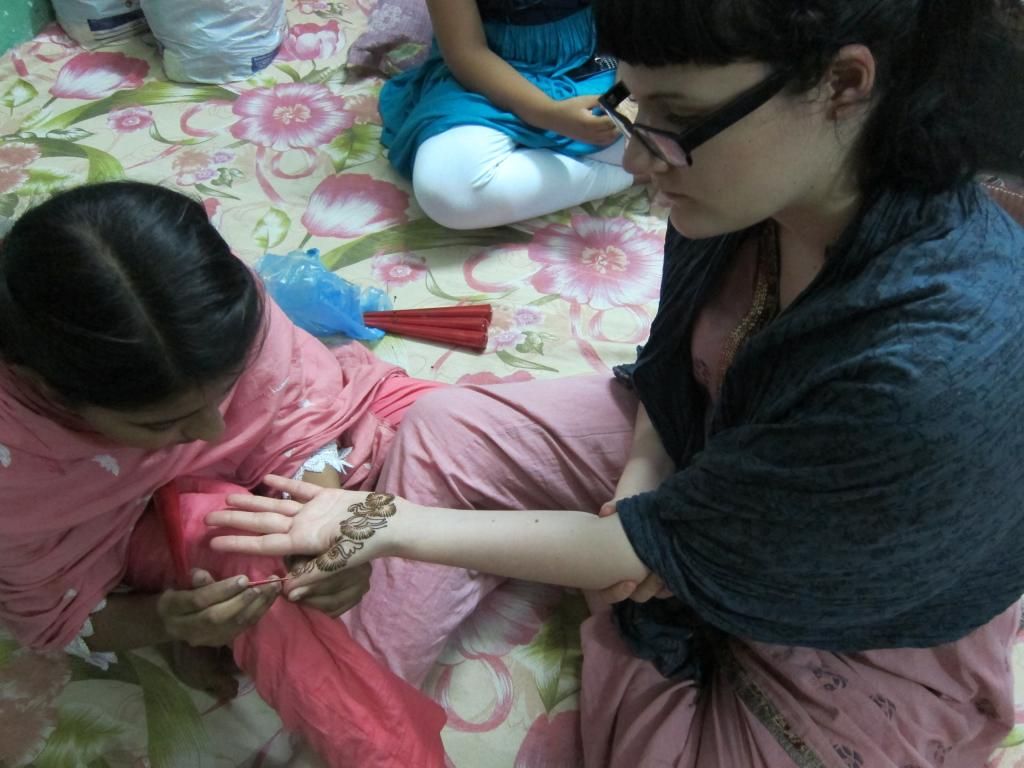
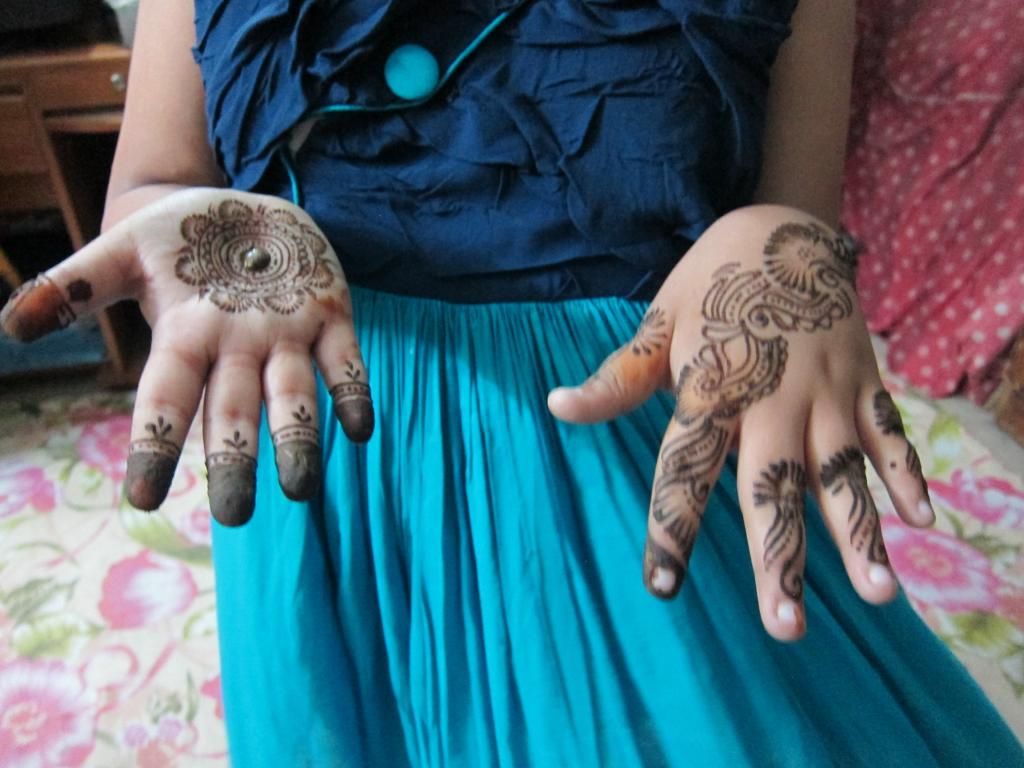
At 2:00 pm it suddenly became urgent that we leave for the parlour to get our mehndi done. Mehndi is the art of applying henna to the hands in an elaborate design, and is usually reserved for special occasions such as weddings. In Pakistan, only the bride applies henna up to her elbows and on her feet. The female guests are limited to designs on their hands, so as not to outshine the bride.
The bride and her cousin left in one car for a parlour, whereas her sister, two cousins, and I would be going to the market to find another place.
The car dropped us off at the bazaar, the same one which housed the jewelry store I visited on the first day. Surrounded by disfigured buildings, people maneuvered through a puzzle of cars and street carts into tiny, unmarked shops. The parlour was on the second floor, and had only a curtain for a door. When we pulled back the curtain we were shocked to see that the parlour was scarcely bigger than a bathroom. It had only two chairs, both of which were occupied by women getting hair cuts. I had assumed that this place was purposely chosen by my hosts, but apparently no one had been there before, and when we looked through the catalog of their mehndi designs, the cousins acted very unimpressed.
“I want elaborate mehndi,” one said, “this is too simple.” So after some time it was decided that we would go to another parlour for henna. The youngest sister began calling other parlours in Karachi, but they were all booked. Defeated and uncertain of how to proceed, we called the driver and returned home around 4:30.
At that point I was told to take a nap, as nothing would be happening in the next few hours. I lay down in the dark room and two hours later I was awoke with a sudden sense of unexpected urgency. [Author’s note: This became a humorous characteristic of my time in Pakistan. Wait around for two hours, then suddenly everything becomes urgent.]
I was told we would be getting mehndi done at the house of the family’s former servant. She was a very poor woman, so she would appreciate the money, and besides, all the parlours in the city were full.
At 7:30 our driver careened through the dark alleys of Karachi until we came up a hamlet of tiny concrete structures surrounded by a wall. The driver pulled his car right in front of the gate and we hurried from the car door through the entrance, careful not to linger for any time in the street.
When I imagined the home of a servant, I had expected a small hut, but instead I found myself in a sprawling maze of concrete hallways and rooms. The hallways themselves had no ceiling, but the rooms did. There were no doors, only curtains to separate the rooms.  Although old and in obvious need of repair, I thought the house seemed like a large and specious living quarters. We were guided by the sister down the long hall and through a curtain on the right, where we suddenly found ourselves in the room of the former servant. She was an old woman, in a bright orange shalwar kameez. A young man slept on the floor, atop a bed that was made of three naked couch cushions placed side by side. Two girls sat in the corner, silently watching us.
The old woman greeted the sister, and the after an exchange of words the sisters face became grim.
We had forgotten the henna.
“We had to buy henna?” asked the cousin.
“Of course we have to buy henna,” the sister replied.
The servant did not have the money to buy henna in advance, so we were supposed to buy it and bring it with us. Now it was past dark and too dangerous for a woman to walk on the street. The driver had also gone to pick up other family members, so there was no chance we could call him and have him take us to buy henna.
getting my home made mehndi
Apart from the sleeping and obviously ill boy on the cushion, there was no other man we could ask to get the henna. After some hesitation, the old woman said she would go out and buy it. The sister gave her rupees, and I watched as the woman covered her bright orange kameez with a black abaya, clearly the only abaya she owned, and tied a black scarf around her head and face.
Alone in the stranger’s house  I took time to carefully observe my surroundings. The walls were two-toned, a dark sea green from the floor to the middle of the wall, and a mint green from the middle to the ceiling. Illuminated green Christmas lights were tacked to wall, spelling out the word “happy” in English. Below a plastic streamer taped to the wall seemed to spell out the word “I'm” but the sentence was left unfinished. On another wall hung a faded blue picture of the hajj, a sign that we were in the home of a Muslim family.  Opposite the hajj picture, was a shelf with an old box television. In the corner of the room, tucked away in a small alcove, was an ancient sewing machine. A black iron beast from the industrial age.  There was nothing else in the room. The floors were concrete, like the walls, but there were no carpets or rungs, only a floral sheet separated us from the concrete floor.
I asked the sister about the dwelling, mistakenly thinking that the entire compound belonged to them. I was then told that this compound was shared by many families. Each family had one room with only a curtain door, but there could be as many as six people in that room. We were not sure how many people were in this woman’s family, but the sister was fairly certain that the sleeping boy and the two young girls also lived in this one room. The kitchen and washrooms were shared by all the residents in the dwelling. 
Though we had an abundance of time and awkward silence, I didn’t ask any more questions or talk about things in the room. I wondered where they prepared meals, where and how they ate them, how they took baths or used the washroom. I wondered about many things in their daily lives, but I didn’t ask any more questions. The sleeping boy hadn’t stirred a bit since we arrived, and the girls kept their gazes low in deference.
Nearly an hour passed since the woman left. We began to worry after thirty minutes, but I could not decipher the source of concern from the sister or cousins. Were they worried that the lady encountered some dangers on the dark streets of Karachi? Or were they just annoyed that she took so long, and worried about their henna designs?
Just as these thoughts were floating around in my hear, the women returned with two bottles of henna. They were about 30 rupees (or 30 cents) each.
She called the girls over, and the three of them began to do our henna in a rush. One girl did my hands while the woman and another girl did henna for the sister and one cousin. The other cousin said she would wait and do hers tomorrow, so she watched as we got our mehndi done.
The girl worked silently on my hands, showing no emotion and making no sound. I passed time by studying the embroidery on her kameez, and wondering how she spent her days when she was not applying mehndi to the hands of a foreigner.
The driver picked us up at 9:00 which was the time we had pre-arranged. In the end, we only had 45 minutes to get our mehndi done, which was not enough time for any elaborate design. After we returned to the house I was told not to wash my hands for 12 hours or even try to peel of the henna, but the feeling of dry henna on my skin, and that sickening earthy smell made my hands feel wretchedly dirty, so I ended up wiping it off within hours of returning home.
The girls were horrified when I came out of the bathroom with my orange hands.
The henna is supposed to turn deep red, but on my hands it was a light orange.
Ancient Ceremony, modern technology
“You’ve ruined it!” they exclaimed, but by morning the henna had turned dark orange, and by the following afternoon it was burnt orange. Although it was not as beautiful and the deep ruby color of the cousins henna, I was still pleased with my simple design.
Then, as if our day was not busy enough, I was told that we would perform the Tel ceremony before going to bed.
The Tel Baan is a small ritual that takes place in the home of the bride. Guests take turns gathering around a small shrine, dipping their fingers in oil, and rubbing it on the bride’s head. A priest was called to the house to perform the ritual, but we were all shocked to see how young and handsome the priest was. He could not have been over twenty-five years-old, with a checkered shirt a wide black rimmed glasses. He was the most modernly dressed of anyone in the room. During the Tel, one of the cousins called a relative on skype, and held the laptop next to the shrine and recorded the ceremony for the distant loved ones to see.
The ancient ceremony stood in stark contrast to the Skype screen.

Dinner was served at home, around 11:30 pm, and pots and plates were again passed around to the guests. When we finished eating, and finished talking, I again made it to bed well after midnight. 

Leopard nights

Bought this leopard coat at a thrift store in LA about 8 years ago. I loved it when I found it - I had been looking for that exact coat for ...