Thursday, July 18, 2013

Western Women Working in Japan

I am now getting ready for my new life abroad. Thankfully, up until June, I worked at a college, and this made researching for my new job relatively easy. 

One of my colleagues and mentors published this book in 1995, and in 2013 I picked it up and hoped to follow in the footsteps of those courageous business women before me. 

In the very beginning of the text, the authors describe the target of their study: high-level professional women in Japan working in fields besides teaching (English instructors are by far the largest group of western foreigners in Japan). At that time, professional Western women in Tokyo were very few, with the study estimating that there were only around 200 professional (non-Englih-teaching) women in Tokyo in the early 1990s. These women were composed of company transfers (very few), trailing spouses who found jobs after relocating to Japan for their husband's position, and a substantial group of women who moved to Japan on their own, and begun searching for employment. 

For me, I could see a lot of myself in the latter category of women. They were the go-getters. The ones who risked moving to Japan and with no job security and somehow they managed to make a life for themselves there. Although I have a gig lined up in Japan, I am hoping to make a successful career change while I am there, and I will likely be working in the field of international HR. I want to be one of these "'globalists' – people who 'think across borders' in their task of marketing, producing, or managing resources. Such global thinking demands that firms have people able to act as 'chameleons,' casually and comfortably adjusting to and thriving in multiple cultures and settings" (4).

Although much has changed in the last two decades since the book was published, I still gained a lot of insight into the journey I am about to embrace. 

To that end, I have compiled a list of the skills I am hoping to acquire though my experience overseas this year:

  • Improving my language ability

I'm far from fluent in Japanese, but I hope to at least become proficient in a professional setting this year. Language skills are important because "the greater a woman’s ability to communicate verbally, the more she perceives her acceptance as a professional as positive" (91).

  • Forming relationships with coworkers despite a linguistic barrier
While we are on the topic of language, one advantage to increasing my Japanese ability is that it will allow me to bond with my coworkers. I have never actually had the chance to form professional relationships with people who were not at least conversant in English, so this is an exciting new challenge. "A clear and strong connection between their job and work adjustment and the quality of the relationships they have with their Japanese colleagues and other with whom they work (105)

    • Increasing my tolerance of ambiguity
    I need to increase my ability to thrive in situations with minimal (or no) guidance and instruction. Management styles in the west involve giving clear guidance and expectations, but that is not the case in Japan (or much of Asia) .

    • Learning how to adjust my expectations
    I talked a bit about this when I first learned my placement. Its almost impossible to enter into a new situation with no expectations, so I at least need to learn to adjust them accordingly as new information becomes available. 

    • Learning how to quickly and affectingly adapt to new situations
    "A key to living and working in successfully  a foreign culture is the ability to adjust to new ways of doing things" (103). Along with adjusting my expectations, adaptation is critical to succeeding abroad. 

    •  Learning to work with and without autonomy
    Autonomy was one of the things I loved about my last job, but in reality, I cannot expect to always work in positions in which I am granted the same level of autonomy. There may come a time I  have to deal with micromanaging bosses, nosey colleagues, and inefficient or less-than-competent teammates. Because Japan is such a collectivist society, it is unlikely that I will find a position which gives me the kind of autonomy that I had in the West, so I will need to learn how to better thrive in a team. 

    • Reading the air 
    The Japanese expression for this is 空気を読む (kuki wo yomu),  which literally means, "reading the air." This skill refers to one's ability to decipher  the  unspoken thoughts or feelings of a group of individual. Japanese society is such that people are unlikely to feel comfortable expressing their feelings directly, so one cannot expect direct feedback and instead must try to sense others' thoughts. 

    • Knowing how to choose my battles

    This is an important one. I know it seems pessimistic to anticipate the negative elements of a job before it has begin, but I certainly cannot expect or assume that everything will go my way. Learning which elements of my new role I should challenge and which I should accept will make life a lot easier:

     "Women gained flexibility from dealing with Japanese attitudes toward woman professionals in general. As they experienced sexual bias and harassment, they cultivated the ability to recognize and understand another cultural perspective. By grasping that perspective, the woman also said they learned to concentrate on the important aspects of their jobs and to avoid being pulled into peripheral frustrations….Learning to sort out the unimportant ones(letting Japanese men precede her onto the elevators)  had taught her to focus on the essentials of relationships rather than on surface behavior" (125). 

    • Building up emotional resilience
    I once took an intercultural competency assessment which rates how prepared an individual is for dealing with intercultural contexts. With all my traveling and experience, I thought I would nail it....and it did...except for one area: Emotional Resilience. This means that when I fuck up, I practically beat myself over the head with a dictionary, and it takes me days to recover. In fact, I was so upset at having failed the Emotional Resilience section, I brooded about it for weeks....hence, proving the point of the assessment. Inevitably, when I am in a new environment, I'm going to screw up a lot, and I have got to learn how to bounce back quickly and learn from the experience, instead of scolding myself and crying in the bathroom from embarrassment. 
    Makes sense. 

    Monday, July 15, 2013

    Pakistan: The Highs and Lows

    This is the list of things I loved and didn't love about Pakistan. I hesitated in calling this a list of "Bests and Worsts" because I really doubt that my mundane musings and annoyances are the absolute best and worst things about Pakistan....

    This includes both tangible and intangible items, feelings and experiences. These are not all things that are necessarily unique Pakistan, nor is everyone bound to experience what I experienced there, but if you are curious about what one solo female traveler liked and didn't like about this relatively un-traveled country, here is my list:

    Best things about Pakistan:
    • The people. By far the best thing about Pakistan is the Pakistanis. Of course, I came to Pakistan as a guest, so I was treated with the utmost hospitality by the families hosting me. However, in my rare moments alone, I found that even strangers were friendly and welcoming.
    • Sugar. I loved sugar! It was so refined and dissolved into tea so easily. I have never found such sweet and delicious sugar elsewhere. 
    • Cheekus/Chikoos/Cheekoos. The brown chocolate-tasting fruit, which is so sweet people with diabetes  cannot eat it.  
    • Cheeku fruit
    • Orange Juice. Fresh-squeezed form the juice cart, and served with a pinch of salt to enhance the flavor
    • Coca Cola served served in a glass bottle and not sweetened with high-fructose corn syrup, and it has a cool Urdu label.
    •  Tea: boiled in milk and so thick and so strong.
    • McDonald's Iced latte: being so creamy and frothy, possibly because the milk is better in Pakistan
    • Cool windy at nights coming unexpectedly at the end of a long hot day.
    • The stars: abundant and visible at night, (and thanks to load shedding, even the cities are dark at night)!
    My not-so-favorite things:
    •  Load shedding, also known as rolling blackouts. In some places, you have less than 12 hours of electricity a day. Most people use generators but it is still inconvenient.
    • Naan.  Pakistani naan is totally different than Indian naan. It is very thick, and has the texture of pizza crust. I missed the thin, puffy, Indian naans.
      Pakistani Naan
    • Heat and sun. Enough said.
    • Guns. They are everywhere in Pakistan, especially Karashi. Everyone has a gun, military, police, security guards. You get used to seeing guns everywhere. 
    • Curfew. Most young women in Pakistan have curfews of around 9:00 pm. If you are staying with a family, expect to be home after sun down, unless you are out with the family. Even if a formal curfew is not in place (because you are staying in a hotel, etc), it is good to know that most women do not go out at night due to safety concerns. I am a night creature and I missed being out in the darkness, though cities are not particularly well-lit at night (due to load shedding) and nightlife in the forms of bars and club does not exist (though house parties and underground raves certainly do). I should mention that I also got very delayed jet-lag towards the end of my trip, and this made me want to go to bed at 8:00 pm every night. Despite all this, I had a few opportunities to be out after dark, and I remember them all vividly: once at the pani-puri cart in Karachi, several times in Lahore (at LUMS, at a juice cart, and at a rooftop restaurant), and once in Islamabad on the rooftop of the home where I was staying.    
    I will be writing in greater details about things like load shedding and safety in my next post, Pakistan: Know Before You Go.

    Wednesday, July 10, 2013

    So I got Shimane

     Not long ago, precisely  April 3rd, 2013 at  10:00 am, I sat on the  bed and waited in immense heat for the power to come back on. I was in Lahore, Pakistan, and the Punjab province is notorious for load shedding, which means that most homes only have power for 12 hours a day. With no power that means no Internet, no AC, no electricity.

    As soon as I heard the electric click of lights, that meant the wifi was back on. I pulled out my phone and opened my email, and at that exact moment I learned that I was shortlisted into the JET program, which meant that I would be living and teaching in Japan for one year.

    That was a good moment for me, even in 100-degree heat I was happy to read that email. And almost two month later my placement was decided.

    That was, well, less of a high moment.

    I was back in Portland at work that morning, and the email came in from the Consulate:

    Shimane-ken (prefecture)
    Kawamoto- cho (town)

    My first thought was, "Shimane-ken. Great!" I had been to Izumo-shi in Shimane, and loved it. I also knew it was close to Hiroshima, which was my top choice for placement. Basically, I decided that I would be happy anywhere on Honshu, and preferably south of Tokyo.
    Well, I got my wish, but then I began Googling Kawamoto-cho, and I became as disappointed as could be.
    Why?

    Well, let's start with the basics:
     - Kawamoto has a population of less than 4,000. The most inaka (rural) place I had ever been was Izumo, and that city had a population of 82,000. There are high schools in Texas that have more than 4,000 students.
    - Because of its size and location, Kawamoto has limited public transportation (train only comes 5 times a day), and a few buses, which meant I was going to have to drive.
    - There is only one conbini, two restaurants, and one grocery store in the city. To me, this makes for one hell of a boring week.

    I began to panic. I didn't exactly put all my hopes on being placed within walking distance of a Starbucks (though that would be heavenly), but I did request urban placement (and I'm sure so did 5,000 other applicants) and I did note on my application that I would not drive.
    Having placed me in the most rural town possible,  it at first seemed to me that the program completely ignored my placement request.

    I thought I loved Japan and would love living in Japan, but then I realized that the things I love about Japan are really things I love about urban Japan:

    1. Efficient public transportation
    2. Access to a variety of restaurants and cafes, at all hours
    3. Shopping paradise
    4. The randomness at which I meet strangers on the streets
    5. the queer scene
    6. Non-Japanese food in Japan (i.e. McDonalds, Italian, Freshness Burger)
    7. People in amazing fashion

    None of these are  found in my new town at all. At all.
    With that in mind, I realized that a mental adjustment was in order. I was not going to have the kind of lifestyle I imagined myself having. What I was getting into would be entirely different.
    I could have rejected the offer, or I could stop being a sissy and start preparing for my new life.

    I started researching things about my new town, and most importantly, I got in touch with a few of the current Americans living there. After hearing from them, I had a very real picture of my life during the next year.

    Before I quit my job on May 31st, my coworker asked me what I was looking forward to about my new life in Japan.
    The first things that came to mind were pretty superficial: deep bathtubs,  candy, TV, and beauty products. Then I thought more specifically that I really just love life in a Japanese home, the tatami, the tiny refrigerators, the toilets separated from the sinks separated from the bathtubs. Then I thought more about me, in a Japanese home, and I came to understand what I am really looking forward to:

    Living alone.
    I have always wanted to know what kind of person I would be if I truly lived alone. My whole life I have always shared a residence. First with my parents, then roommates, boyfriends, girlfriends. I have never actually had my own place, to be decorated in my own fashion. More importantly, I have never lived without being conscience of another presence. I want to know if I am messy or clean. I want to know if I can live sparsely, or if I must be surrounded by things. I want to know how I spend my free hours. Will I be disciplined and write my novel and study Japanese as I hope, or will I spend my evening hours mindlessly surfing the Internet and watching TV? Will I love it or hate it? Will I learn to conquer my fears of noises and the dark?  These are things I wish to know.  I have wanted to experience this before I get married, before I never know what kind of person I would truly be living alone.
     
    On that note, conquering my fears has to be another thing I am looking forward to. I am outrageously afraid of bugs, being alone in a dark house, unexplained noises, and driving on the opposite side of the road. Life in Japan is going to give me a big dose of all of those, and I am going to have to find a way to deal with it.

    Also, if I am going to become the adventurous, jet-setting woman I have always wanted to be, I need to work on  getting over my issues. I don't mean life issues. I mean stupid-ass petty things. Like how I can't sleep without my childhood pillow, which I have had since ten years old. And how I have always hated E-readers. If I am going to travel around the world, I can't be lugging a pillow and twenty books with me. On that note, I have always had an annoying addiction to Starbucks. Since I will be moving to a place where the nearest Starbucks in two hours away, I will need to rid myself of this addiction.

    Lastly, I am looking forward to reinventing my lifestyle. Since I will be living in the rural mountains, I will have some splendid opportunities to exercise every day, and eat healthy organic vegetables and fish. 

    Needless to say, I am now viewing my placement as a blessing, not a curse.  There, I will have the opportunity to learn about an entirely different way of life, something I can't experience living in the city. Because of my future career goals, it is likely that I will be living in cities all my life, so I should look at this as a once-in-a-lifetime opportunity to live life in the countryside, and experience the heart of Japan.

    Sunday, July 7, 2013

    Gloria Jean's in Pakistan


    I hate to admit this, because it sounds so very "Western" of me and undoubtedly comes with the label #firstworldproblems:


    I have a latte addiction.


    I need lattes like the third world needs air-conditioning.

    It's pathetic, and I am ashamed of my pampered existence, but I need it. Seriously.
    To make things worse, there is no substitute for a latte in my mind. Not black coffee, or tea, or any other drink can suffice. I need a damn latte.

    Nothing made this more apparent to me than the first  three days I spent in Pakistan, having latte-withdrawals. During this time in Karachi, I had only left the house once - to visit the pani puri cart, but from what I had seen I was convinced that Pakistan was a latte-less country. Resigned to this idea, I agreed to go to the mall to look for juice. Juice in Pakistan is great by the way, but it's not a latte. To my surprise, there was no juice to be found at the Dolman Mall in Karachi...

    But there were lattes!

    Gloria Jeans in not native to Pakistan, but it is one of the only (or the only?) coffee chains in the country. 

    And guess what?
    It's awesome.


    The counter with baristas

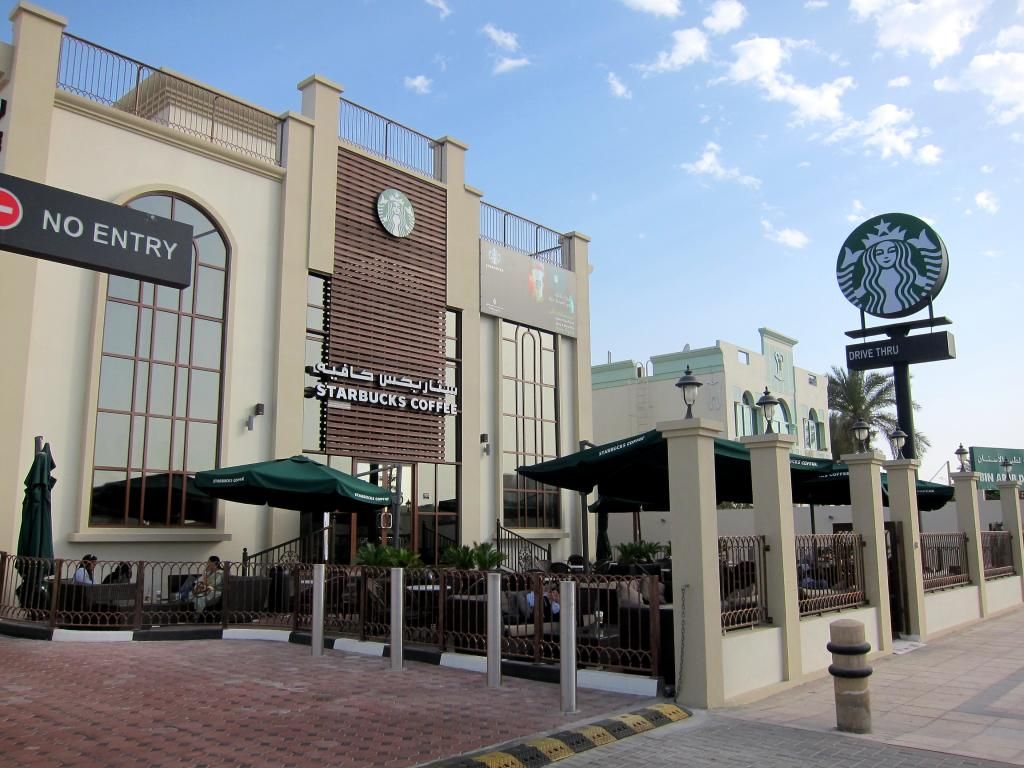
    Pakistan is among those few countries in the world where there is no Starbucks. This doesn't surprise many people in the  U.S., but what  may surprise them is that Pakistan's Gloria Jean's stores are every bit as modern, as delicious, and as air-conditioned as any Starbucks.


    beautiful seating


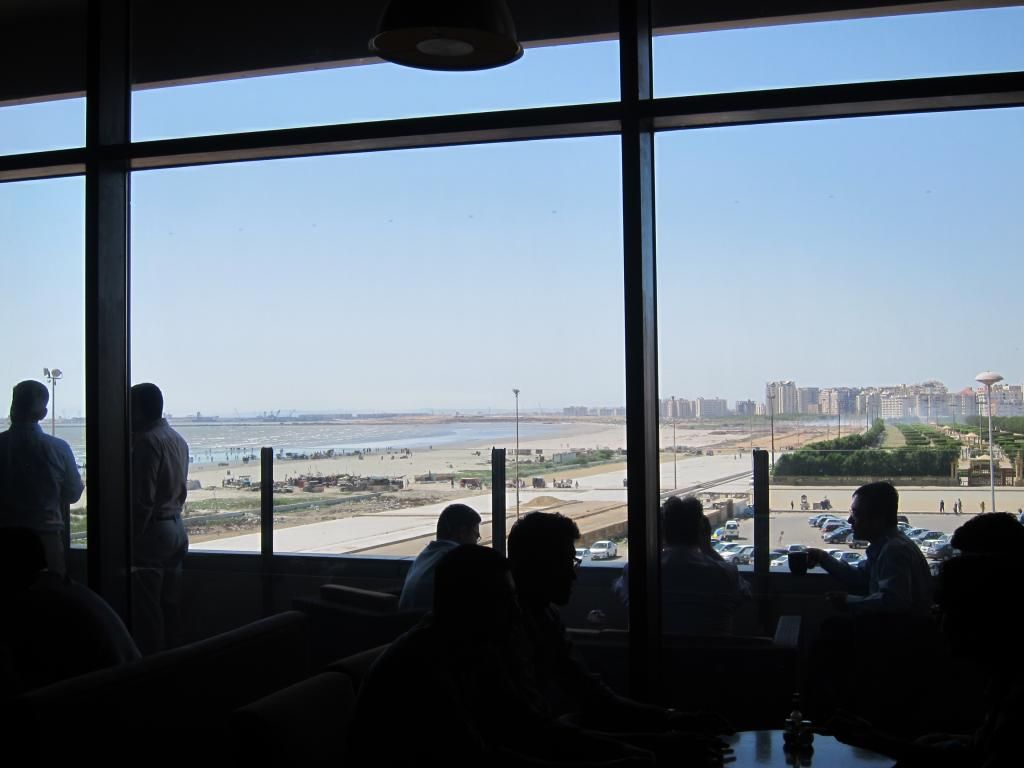
    The Gloria Jean's in the Dolman Mall in Karachi  is especially classy. It not only boasts abundant indoor and outdoor seating, but also has beautiful views of the beach. I didn't even realize that Karachi had beaches until I saw them out the window!


    views of the beach in Karachi!

    After experiencing this Gloria Jean's, I demanded - well, politely requested - that my hosts in Lahore and Islamabad take to me Gloria Jean's in those cities as well. I was never disappointed. Although the other Gloria Jean's did not have ocean views, they were all remarkably clean, well decorated,  and cool! 

    My drink of choice was the Creme Brulee latte in all its many forms. I had it hot, over ice, and blended.  
    Thank you Pakistan for this wonder memory. 
    Thank you Gloria Jean's. 
    But most of all, thank you Pakistani friends, for putting up with my annoyingly American obsessions. 

     
    Hot Creme Brulee latte
    Creme Brulee latte over ice

    Creme Brulee latte ice blended

    Thursday, July 4, 2013

    Why I chose the JET Program


    After a much  documented epiphany in the summer of 2011, I decided that I would be quitting my job and moving to Asia  in the summer of  2013, no matter what. At that time, I had no idea what I would be doing, but I had some options.

    I could move abroad:

    A)   As a student (Graduate school, foreign language study)
    B)   As a professional (English teacher, some awesome ex-at gig)
    C)   As a tourist (Blow my savings hopping from country to country)
    D)   A combination of two or more of the above

    All of these came with pros and cons.

    Going abroad as a student is expensive, and although it can be rewarding, it is a costly way to acquire new skills.

    Getting a job would be ideal, but that also depends on the kind of job. I had no desire to teach English forever, or become a corporate drone working 12-14 hours a day like some of my friends in Tokyo and Taipei. Come to think of it, I didn’t really know exactly what I wanted to do professionally. So the chances of me finding that dream job, the one that satisfies desires I don’t even know I have, seems unlikely.

    Being a tourist was probably my least favorite option. This is by far the lowest bang for your buck. Traveling is expensive, and it does not guarantee you a transformative experience. You could easily blow through thousands of dollars traveling to every country in Europe, but learn very little and the cultures and societies into which you have briefly inserted yourself.  On the other hand, you could get extremely lucky and end up meeting great local people who help you land your dream ex-pat job, but the chances of that are slim, and that is an expensive gamble.

    Going through these options I immediately ruled out tourism, since I wanted to some assurance of acquiring new skill sets and credentials. I also immediately ruled out graduate school, as I had no idea what I program of study I would select, or how, specifically, a graduate degree would advance me to the next stage in my career. (Tip: if you can’t answer that question, you are not ready for graduate school).

    Foreign language study (Japanese or Chinese in my case) was a likely option.  I even visited the Mandarin Training Center at NTNU in Taipei on my trip in March of 2012. At the time, I was seriously considering moving to Taipei by fall of 2013 and starting my Chinese study then. But….I also didn’t know how acquiring Chinese language skills would play into my career. It seemed that I wanted to move to Taiwan more for the watermelon drinks, trendy fashion, and cheap food  rather than advancing my career, and saw Chinese language as a means of obtaining said drinks and food, rather than a necessary skill.

    So it looked like I was going to Asia as a professional.  But where, and how?
    I started researching opportunities around Fall of 2011, and I narrowed down my possibilities to the JET program (teaching English in Japan), a teaching program in South Korea, and an internship with an NGO in Cambodia.

    The NGO gig  in Cambodia was by far the most interesting, and really aligned with what I had been doing professionally in the U.S.. I considered JET and this South Korea gig as back-up in case Cambodia fell through.

    But all that changed when the application deadlines approached.

    JET had the earliest application deadline, November 2012 for departure set in August 2013. The deadline snuck up on me so fast I had to scramble to get my application together and overnighted it to the embassy in DC. I almost didn’t even apply due to the stress in assembling my application. However, it was ultimately my partner who encouraged me to apply, even as a back-up, because if I missed the deadline I would not have another chance to apply until next year.
    So I did.

    When the South Korea application deadline came up I was ready, because it was almost identical to the JET application, so I had everything I needed to submit it on time.

    I interviewed for the position in South Korea via Skype while I was at a house party in Dubai. I sat on the floor of my friend’s living room while everyone drank alcohol (shhhh..it’s illegal) and played loud music on the patio.

    I interviewed for the JET program at the Portland Consulate. I was nervous as hell when I went in, but somehow the interview was surprising fun, and I walked away feeling a renewed sense of interest and enthusiasm for the JET program.

    The Cambodia application had the latest deadline. I began filling out the application after returning from Dubai and Pakistan. During that process, I was required to provide an outline of my finances and expenses in Cambodia so that I could be considered for a scholarship, because the internship stipend was so measly (even for Cambodia).  Through this process I realized the this internship was going to cost me an overwhelming sum of money, even with a scholarship and stipend, so I was really forced to consider how much value I placed on living in Cambodia and acquiring experience with this NGO.

    Ultimately I was accepted into all the gigs, and I ended up choosing JET. It was a tough decision, because I really wanted to go to South Korea and Cambodia, but here was my rational:

    1. JET paid the most. Not only would I be able to live comfortably in Japan, but I may even be able to save money.
    2.  Because it’s Japan. I have always had a place in my heart for Japan, even since that visit to the Ushiku Daibutsu in 2002. I always wanted to know what it would be like to live in Japan, and now I would get the chance to do that.
    3. I was planning on traveling in Japan anyways. If I had done the gig in South Korea or Cambodia, my original plan was to still go to Japan for three months on a tourist visa and write my novel in Hiroshima (my favorite place on Earth) as well as visit a few cities I have not explored (Aomori, Sapporo, etc). By doing JET I would have the opportunity to write my novel in Japan (my novel takes place in Japan so it is important that I be there while writing it), and travel on the weekends and holidays…and get paid for it!

    Honestly, I’m not proud to admit that money played a huge factor in my  decision. It sounds very superficial, but to all those people who constantly ask me “how do you get money to travel?”  - this is how:
    I make smart financial decisions.
    I don’t work for free or for measly amounts.
    I save money.
    I make sacrifices.
    Sometimes that means that you can’t take the cool NGO gig in Cambodia, or be a language student in Taipei, because it would eat into your savings.
    But is does not mean that you continue working your cushy 9-5 job in the U.S.  and never take risks because of uncertainty.

    There is a delicate balance involved in achieving your dreams. There are times when you takes risks and times when you play it safe and times when you do both at once. I took a risk quitting my job in the U.S. this June, and I am taking a risk moving abroad, but I’m not putting my bank account in jeopardy doing so, and to me, this is the balance. 

    Sunday, June 30, 2013

    Photo Diary: Temple in Taipei

    I saw this temple on the side of the road while walking through Taipei. This kind of gorgeousity is merely normal for Taipei, as I was told that such temple exists on every street corner. Well! 


    Tuesday, June 25, 2013

    Memoirs of a Morrocan-Zanzibari Wedding

    In Dubai, it's all about who you know.

    Your connections can mean massive hook ups -  I mean - of course, in a professional sense.


    Friends are your key to jobs, apartments, visas, and all sort of opportunities.

    Sometimes, even weddings. Morrocan-Zanzibari Weddings.

    Let me paint a scene for you.


    It's around 4:00 pm in Dubai International Airport, Terminal 1, which looks and feels, by the way, like a Las Vegas casino. If you've never been to Vegas, imagine marble floors, multi-story ceilings pillars, and fake indoor palm trees.


    I just step off a plane from Pakistan, where I've been for the last two weeks, and I'm in Dubai for one day before taking the 15-hour flight back to the states. I'm expecting my friend to pick me up and take me to her home, where I plan to have a nice hot shower, un-pack and repack, then promptly fall asleep.

    Instead, I'm greeted by my host in a pair of 5-inch heals, and she says, "Welcome back, do you wanna go to a wedding?"


    So a coworker's friend's friend's daughter was getting married, and hosting an immaculate party at one of the upscale hotels in Dubai. If course, this being Dubai, we were not the only foreigners there. Neither the couple nor the guests were from the region. The bride was from Zanzibar, and the groom was from Morocco. Both, I heard, were now living in London.


    The ballroom


    guests lining up to dance

    This particular wedding function was an all-female post-wedding reception,  lasting from 2:00 pm until 10:00 pm. Apparently the wedding ceremony itself had taken place that previous night, and on the following day the are single-sex segregated events to celebrate.

     When we arrived at 5:30 the bride and groom had not even shown up yet. Instead, guests feasted on the buffet and danced for another two hours.

    I liked being at a party of all women. After enduring cat calls and suggestive glances from practically every man on the street in Dubai, it was very relaxing to being in an all-women environment.

    It was also nice because, instead of being surrounded by women in black abayas, I actually got to see what they were wearing underneath! When women entered the party, the would be covered in black head to toe, but once inside the ballroom they would remove their abayas and head scarves and drape them over the chairs. Underneath they wore the most beautiful and exquisite gowns I have ever seen. Some of their gowns were also extremely sexy and revealing. I'm talking skin-tight, full cleavage exposed, mesh-fabric-with-pasties-kind of revealing.
    Too bad I didn't get a picture of that...


    some women did leave their headscarfs on

    abayas draped oer chairs


    food from the buffet


    the bride enters with her entourage

    When the bride and groom arrived they entered the room followed by a procession, like a king and queen. They were then both seated on a stage and watched a belly-dancing show. Later on gifts were presented to them, and the guests continued to dance. Finally, for only a few minutes, the bride stepped down off the stage and danced with her friends in the crowd.


    Honestly, it did not look very fun to be a bride  at this ceremony, sitting on that stage in silence. She did not have a chance to eat the food, and she could not walk around and mingle like I could with the crowd. It seemed way more fun to be a guest.


    I absolutely loved the bride's dress and hijab. She looked like an exquisite queen. I didn't know that head coverings could be so elaborate until I saw her. True to hijab, she had her hair covered, and was wearing a loose-fitting robe which showed no skin. And she looked amazing.


    Just before the couple left, they brought out a huge cake, and proceeded to cut the cake with a long sword. This looked very cumbersome, but it must have been a tradition. I had been eyeing the cake for a while, and was eager to sink my teeth into it.


    To my great dismay however, the cake was so rich that it tasted like a stick of butter, rather than a cake. It was also very dry.

    a dry, buttery cake

    This wedding, like all events in Dubai, was an amalgamation of culture.
    A bride from Zanzibar in a Moroccan dress, with a Moroccan groom, flies from her home in London to her wedding site in Dubai with her mother's Zanzibari friends. A Nigerien-Brazillian American who is a friend-of-a-friend shows up to the reception, and brings along her Greek-American friend who just stepped off a plane from Pakistan. The two friends dance until 9:00 pm, eat cake, then catch a ride home from a female police officer who drives them through the sandstorm to their apartment.

    Dubai, I will miss you, not in spite of your randomness, your craziness, your spontaneity...

    but because of it.

    Leopard nights

    Bought this leopard coat at a thrift store in LA about 8 years ago. I loved it when I found it - I had been looking for that exact coat for ...